

AI in IVF is everywhere. When couples read that software can now choose the embryo, they are already worried when they go to their appointments. The question below is simple. Now that a machine can quickly sort embryos, why do we still need an embryologist?
The embryologist is still there for almost all of it. Software reads images. It does not culture an embryo, and it does not carry responsibility for transfer day.
Is AI replacing embryologists in IVF laboratories? No. Every system in use today is decision support, and an embryologist reviews the output before any transfer decision. This article covers what AI in IVF is, how embryos are graded today, what the software adds to embryo selection, and what it still cannot do. Most of the confusion starts with the term itself, so we begin there.
What Is AI in IVF?
Artificial intelligence in IVF is software that learns to read embryo images. It is shown thousands of embryos whose outcomes are already known, learns which visual patterns go with a pregnancy, then applies that to embryos it has never seen.
That learning step separates AI from ordinary automation. An incubator does what a person told it to do. An AI model builds its own scoring criteria from its training data, which is why two systems can score the same embryo differently.
What the software sees is narrower than most people expect. Time-lapse frames, the timing of each cell division, and measurable features of shape and symmetry. That's its only input.
Is AI Used in IVF Labs Today?
Yes, but not equally. Several methods are on the market and used in clinics, mostly where time-lapse incubators are already present. No standard of care exists for any of them, and most are still being tested.
Does AI make the decisions in an IVF cycle? No. Every output passes through an embryologist before it influences a transfer decision, and that review is built into how these tools are approved.
| Data input | What the algorithm reads | What it cannot read |
|---|---|---|
| Time-lapse imaging | Division timings, cleavage patterns | Patient history, clinical context |
| Static embryo images | Morphology, symmetry, fragmentation | Genetic status |
| Cycle metadata | Age, stimulation response, prior outcomes | Emotional readiness, consent nuance |
The third column is the one worth reading twice. Everything a model cannot see still has to come from a person. That is why AI in IVF has settled into a supporting role rather than a controlling one.
None of that means much on its own. It only means something next to the way embryologists have graded embryos for forty years.
How Do Embryologists Grade Embryos?
An embryologist grades an embryo by looking at it. That sounds basic, and it is, but it is the method the field has run on since the 1990s.
On day three, the embryo is judged on cell number, how even those cells are, and how much fragmentation is present. By day five, it has reached the blastocyst stage. The Gardner system then scores how far it has expanded, the quality of the inner cell mass that becomes the baby, and the quality of the trophectoderm that becomes the placenta.
Why do two embryologists sometimes grade the same embryo differently? Because morphological grading depends on trained visual judgment, and features that are close to being clear can be read in different ways. An embryo sitting between a B and a C is an interpretation, and everyone may interpret it differently. That variability is the reason AI embryology exists as a field at all.
How Are Embryos Selected for IVF Transfer?
The grade is one input. It is not the decision. Embryo selection also takes in:
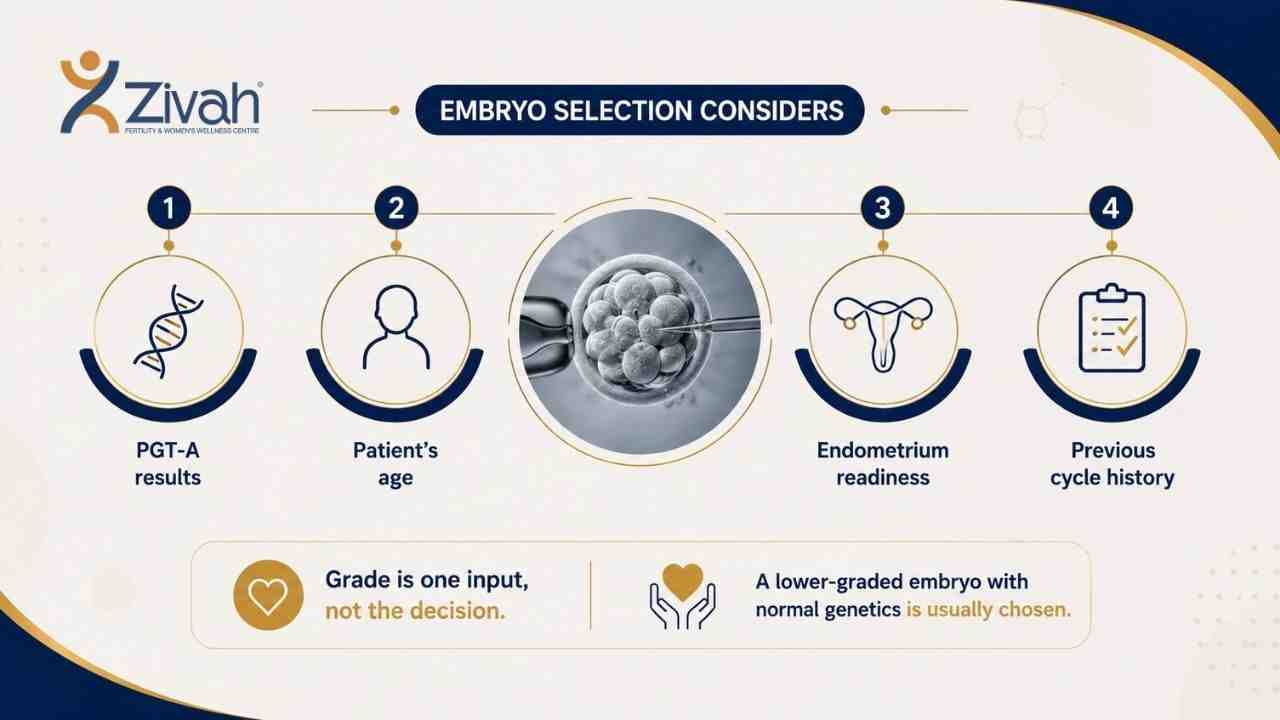
- PGT-A results, where genetic testing has been done.
- The patient's age.
- Whether the endometrium (inner mucous membrane lining of the uterus) is ready.
- What happened in previous cycles.
A lower-graded embryo that is chromosomally normal will usually be transferred ahead of a better-looking one that is not. Grading is a visual task. Selection is clinical, and it draws on things no image contains. The table below puts the two scoring methods side by side.
| Factor | Embryologist grading | AI scoring model |
|---|---|---|
| Consistency across observers | Varies between labs | Fixed and reproducible |
| Speed per embryo | Minutes | Seconds |
| Clinical context awareness | High | None |
| Ability to explain reasoning | Full | Limited |
| Handling of unusual cases | High | Poor outside training data |
Read the first two rows and the machine looks better. Read the last three and it does not.Since there is no clear winner, the field has moved toward using both. That leaves the question of what the software does with an embryo image once it has one.
How Does AI Help With Embryo Selection?
AI embryo selection does not tell you which embryo to transfer. It puts them in order.
The software scores each embryo and ranks them from most likely to implant to least likely. There is no pass and no fail. An embryo ranked fourth out of five is not rejected; it is lower in the order.
That ranking comes from a neural network trained on embryo images where the outcome was already known. The system was shown which ones implanted and left to work out what those embryos had in common. Nobody wrote the rules. The model found them, which is why it often cannot explain them.
What Is AI Embryo Grading?
AI embryo grading is the scoring step. It produces a number attached to an image. Selection is what happens next. Someone reads that number alongside the patient's age, test results, and previous cycles, then decides what to transfer. For this reason, AI-powered embryo selection is a misleading phrase. The software grades. A person selects.
Can AI Improve Embryo Selection in IVF?
In some ways, yes. The same model gives the same embryo the same score every time, and decision time drops from minutes to seconds.
What has not been shown is the thing patients most want to know. Prospective trials comparing AI-based embryo selection with experienced human grading have not shown a clear live-birth advantage. The technology is more consistent. Whether it is better at being right remains open.
Does a higher AI score guarantee a pregnancy? No. The score estimates implantation likelihood across a population, not one transfer. A top-ranked embryo can fail, and a lower-ranked one can work.
The table below separates what these systems can predict from what they cannot.
| Prediction target | Capability | Evidence status |
|---|---|---|
| Implantation likelihood | Probability ranking | Retrospective validation |
| Blastocyst development potential | Strong | Established |
| Chromosomal normality | Correlative only | Cannot replace PGT-A |
| Live birth outcome | Indirect | Under active trial |
| Miscarriage risk | Limited | Not established |
That leaves the question of what the software does with an embryo image once it has one. Just because embryos that aren't working right often look a certain way doesn't mean that's the same as testing for it. AI-assisted embryo screening is not the same as PGT-A. Choosing which embryos to keep is only one part of the lab. The program can also be used at other points in the cycle.
What Is the Role of AI in IVF Beyond Embryo Selection?
Embryo scoring gets the attention, but it is not where most of the software sits.
The role of AI in IVF now stretches across the whole cycle. Sperm selection tools flag the most motile, best-formed cells for injection. Oocyte software helps confirm which eggs are mature enough to fertilise. Stimulation models look at how a patient responded before and suggest what dose might suit her next. Electronic witnessing systems track every dish through the laboratory, matching samples to patients at each step.
That last one is the quietest use of AI in IVF and probably the most valuable. It removes a category of human error that training alone never fully eliminates.
How Is AI Used in the IVF Lab Workflow?
The software runs in the background and speaks up when something needs attention. A time-lapse incubator monitors the embryos and annotates divisions on its own. The embryologist checks the flagged events instead of sitting at a microscope for every observation. The work does not disappear. It moves from watching to reviewing.
Does AI-assisted IVF mean fewer staff in the laboratory? In real life, no. According to reports, missions keep the same number of employees and focus on the tasks that still need help.
The table below shows where the software sits at each stage and who is doing what.
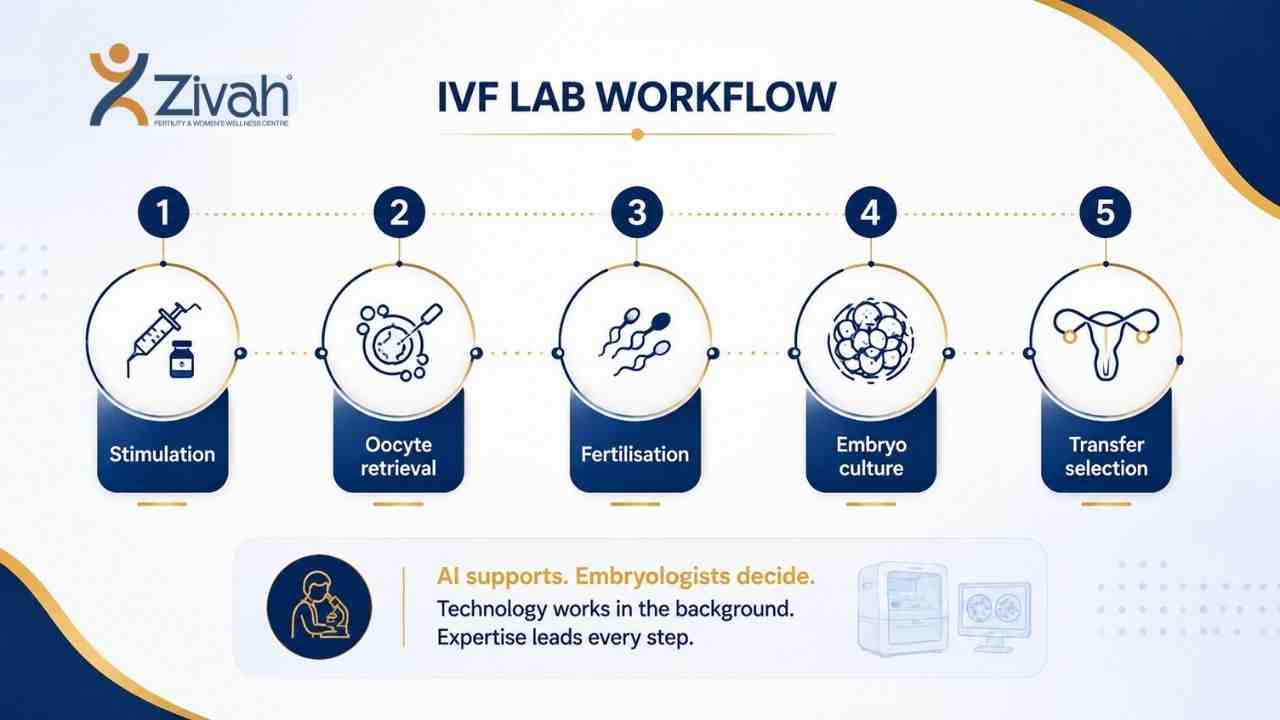
| Cycle stage | AI application | Embryologist role |
|---|---|---|
| Stimulation | Response modelling | Clinician interprets and adjusts |
| Oocyte retrieval | Maturity assessment support | Confirms and documents |
| Fertilisation | Motility and morphology screening | Selects and injects |
| Embryo culture | Time-lapse monitoring and annotation | Reviews flagged events |
| Transfer selection | Ranking output | Makes the final selection |
Look down the third column. There is a person at every stage, and the software never acts on its own. That does not mean it works everywhere it is installed. The limits are worth knowing before anyone puts weight on a score.
What Are the Limitations of AI in IVF?
When moved to a different incubator, a model trained on pictures from one incubator often doesn't perform well. The camera isn't the same, and the software makes the embryos look different. Laboratories address this by rechecking the data locally before trusting it.
The training data has the same problem. Most models were built on embryos from one or two clinics, so accuracy falls in patient groups the model saw little of. Multi-centre validation exists to close that gap.
Then there's the reason a model gave a grade. Many people can't say that. That matters for agreement, and an embryologist can review the results and explain them in plain language.
Can a model trained at one clinic be trusted at another? Not all the time. A model's accuracy often drops when it encounters equipment or patient groups not included in its training set. Regulators have been cautious, approving these tools as decision support rather than diagnostic devices.
One gap remains: nobody knows yet whether children born from AI-selected embryos differ from those selected by eye.
| Limitation | Why it matters | Current safeguard |
|---|---|---|
| Dataset bias | Weaker accuracy in under-represented groups | Multi-centre validation |
| Limited explainability | Complicates informed consent | Embryologist review of every output |
| Equipment dependency | Scores may not transfer between labs | Local revalidation |
| No genetic insight | Cannot substitute for PGT | PGT remains a separate test |
| Sparse long-term data | Child outcomes unstudied | Ongoing registries |
Every row in that third column depends on a person. The limitations of AI in IVF are managed by embryologists, not by better software. Which brings the article back to where it started.
Will AI replace Embryologists?
Grading embryos is a small part of what an embryologist does.
The rest of the job happens with hands. ICSI means holding a single sperm in a needle and placing it inside an egg without damaging either. Biopsy means removing a few cells from a blastocyst for testing. Vitrification means freezing an embryo fast enough that ice never forms. When a culture batch starts behaving oddly, someone has to work out whether it is the media, the gas, the incubator or the technique.
None of that is a visual task, and none of it is what these models were built for. The question of whether AI will replace an embryologist usually assumes the job is looking at pictures. It is not.
Can AI Replace Embryologists in IVF Labs?
No, and the reason is not only technical. Someone has to be accountable. If a transfer decision goes wrong, a patient is entitled to an explanation from a person who understood the reasoning and stands behind it. An algorithm cannot be questioned, held responsible, or present in the room.
Regulators have written that requirement into how these tools are approved, which is why every system on the market is classed as support rather than authority.
How Can AI Assist Embryologists Instead of Replacing Them?
This is where the technology earns its place. Used well, it:
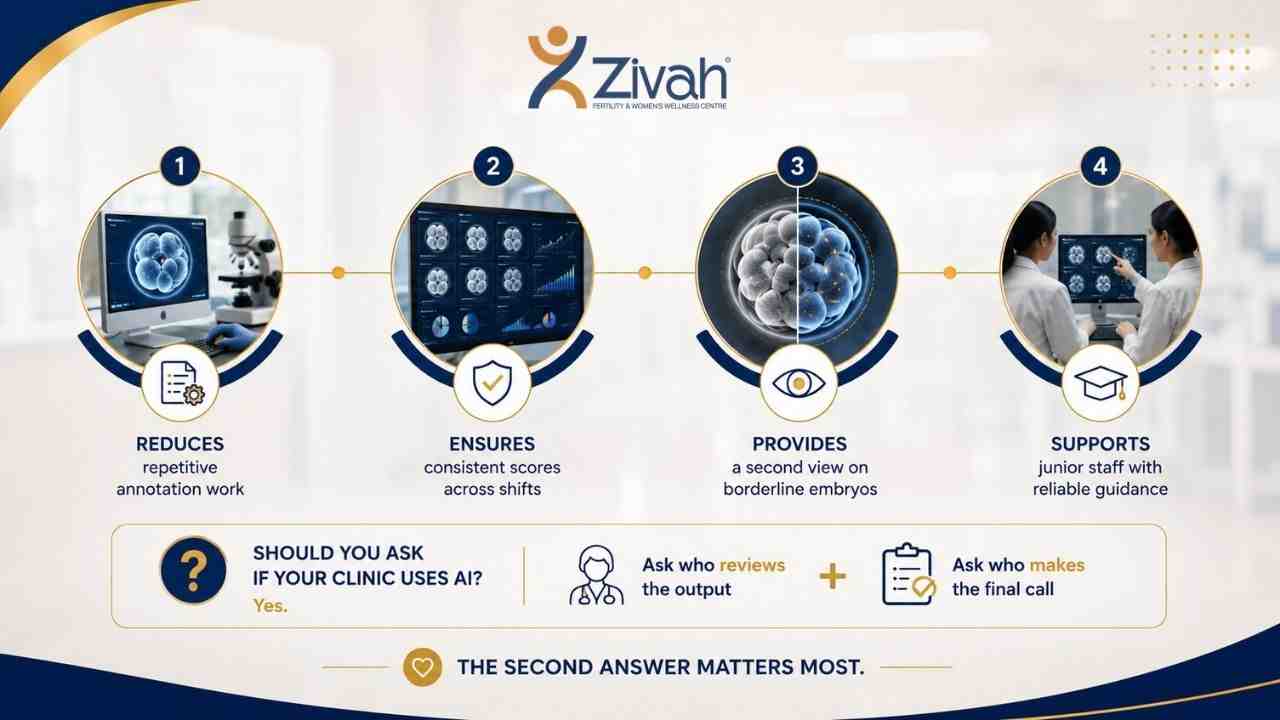
- Gets rid of the day's repetitive annotation work.
- Keeps scores consistent across shifts and observers.
- Gives a second view on embryos that are on the edge.
- Provides junior employees with a reliable guide to use for checking.
Should you ask whether your clinic uses AI? Yes, and ask equally who reviews the output and who makes the final call. The second answer matters more than the first. The direction of travel is clear enough now to say what the next few years are likely to look like
What Does the Future of AI in IVF Treatment Look Like?
The next few years will be about evidence, not new features.
Prospective trials are running now, asking what the earlier studies could not answer: does AI selection produce more live births than an experienced embryologist? Until those results arrive, the technology is proven at consistency and unproven at outcomes.
Regulation is settling on the same principle everywhere. A person signs off because accountability has no software equivalent.
The likeliest change is integration. Image scores, genetic results and endometrial assessment currently sit in separate places, and bringing them into one view is the part of AI in IVF treatment most likely to shift practice. Autonomy is not coming. Nothing in the research or the regulation points toward laboratories running without embryologists.
At Zivah Fertility, the embryology team makes decisions about your embryos, whatever tools sit alongside them.