


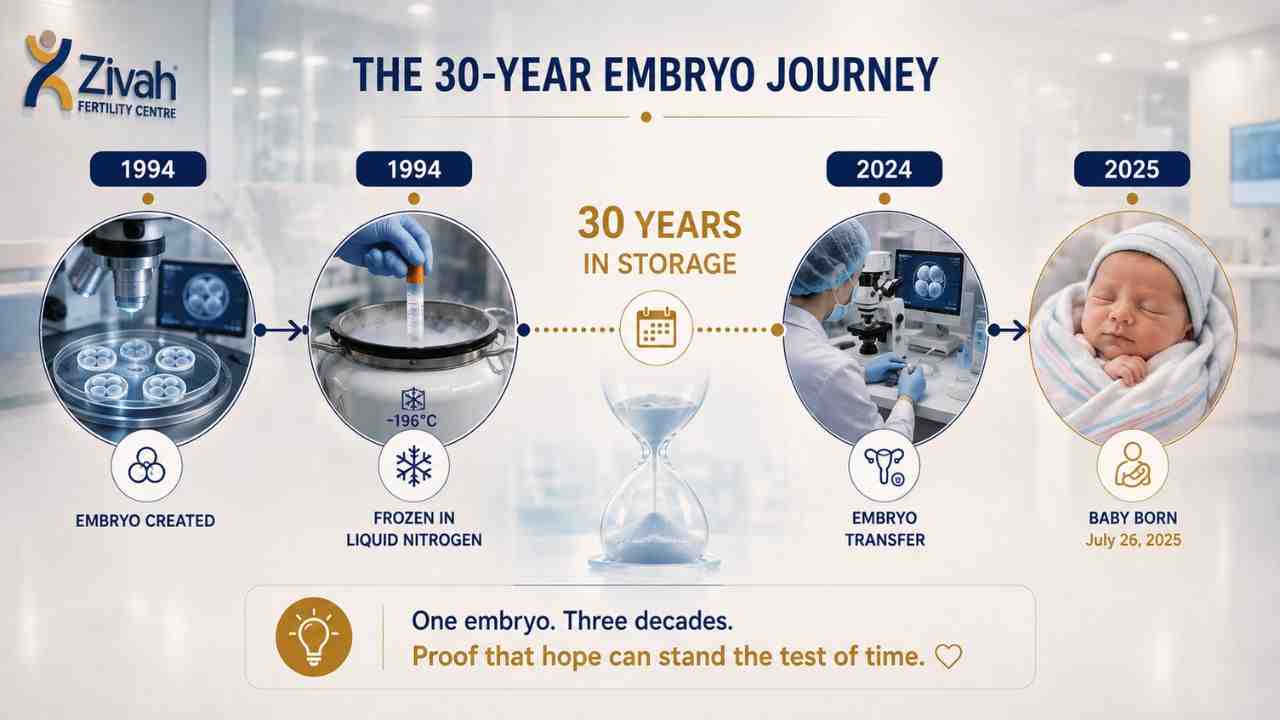
Thaddeus Daniel Pierce was born on July 26, 2025. The embryo he grew from was made in May, 1994. The gap makes him the oldest frozen embryo to be born, a record officially confirmed by Guinness World Records for the longest stored embryo to result in a live birth. The same year he was born, his biological sister turned 30.
That is the detail that keeps most people from doing it. His embryo was created in that Oregon lab when his mother was four years old. His father was 3.
This article covers three things: the family behind the record, the science that maintains an embryo alive for three decades, and what Indian law truly allows if you have embryos in storage right now. And the funny thing is? Pregnancy was good. Almost didn't get the embryo out of the container from 1994.
Key Takeaways:
- Embryo produced May 1994; a baby delivered 26 July 2025, almost 11,100 days in storage.
- At -196°C, embryos do not age. The risk is in the freezing and the thawing, not in the waiting.
- Thaddeus comes from slow freezing, the earlier technology that was superseded by vitrification after 2000.
- In India, embryos can be held for a maximum of 10 years and cannot be donated to another couple.
A Baby Born From the World's Oldest Frozen Embryo
The story itself is hard; the timeframe is easy. In May 1994, four embryos were created in an IVF lab in Oregon. One became a newborn girl. The other three were cooled in liquid nitrogen, where they remain.
Three decades later, they were transported to Rejoice Fertility, a facility in Knoxville, Tennessee, known for taking embryos that other laboratories would not. Two were moved on November 14. Implanted one.
Thaddeus Daniel Pierce was born in Ohio on July 26, 2025. His embryo was then recognised by Guinness World Records and confirmed to be the oldest embryo in the world to lead to a live delivery. The old record remained for less than three years.
Is It 30 Years or 31? Explaining the Numbers
Read three reports, and you will get three different numbers. All of them are right. It's only a matter of where you start counting. The embryo had been stored for 11,148 days, or almost 30 years and 4 months.
It is over 31 years from the freezing date to the delivery date. One more item that should be clarified. "World's oldest baby" is a headline term, not a reality. Thaddeus is a baby like any other. You’re not old. The embryo’s old.
What Scientists Learned From This Birth
The profession has long considered that embryos this old, preserved using the outmoded procedure of the early 1990s, rarely made it. That assumption drove policy.
A programme that adopted these embryos estimated that more than 90% of US clinics would have refused to accept them outright. Then one birth showed a default no one had ever tried. Thaddeus smashed the old record by about seven months and quietly established that there is no limit to long-term embryo storage.
Record-Breaking Frozen Embryo Births: A Verified Timeline
| Baby |
Born |
Embryo Created |
Time in Storage |
Programme |
|---|---|---|---|---|
| Emma Wren Gibson |
Nov 2017 |
Oct 1992 |
24 years |
National Embryo Donation Center |
| Timothy & Lydia Ridgeway |
Oct 2022 |
Apr 1992 |
30 years (10,905 days) |
National Embryo Donation Center |
| Thaddeus Pierce |
Jul 2025 |
May 1994 |
30 years (11,148 days) |
Snowflakes / Rejoice Fertility |
| Typical IVF case today |
Varies |
Same cycle |
2 to 5 years |
Standard clinic storage |
Every post started with the same thing, a family struggling with what to do with unused embryos. That was Linda Archerd’s call, back in 1994.
Linda Archerd and the Three Embryos She Kept for 30 Years
Linda Archerd had been trying to have a baby for six years by 1994. She and her husband had IVF when most people didn’t even know the term. Friends wondered what the hell they were doing. But they did it nonetheless.
That May, four embryos were made. One was moved. Nine months later, Archerd had a daughter, a girl who is now a lady in her 30s and has a kid of her own. The other three 1994 embryos were placed into a storage tank. She figured Archerd would be back for them. Never did. But she never let them go, either.
Why She Kept Paying to Store Them Year After Year
Embryo storage is not free. It’s not cheap. Over the years, the yearly price increased to about a thousand dollars. She paid it. Every year, for three decades. Then life went on, while the embryos were frozen:
- Her marriage broke down, and she preserved the embryos during the divorce
- She hoped to utilise them one day, maybe with a new partner. That day never came, but the storage bill did.
They were her three little dreams, she added, since she always thought they received the same opportunity her daughter did. Any IVF patient would know this situation. Nobody signs the consent form thinking they’re going to be paying for thirty years.
Menopause, and the Choice She Couldn't Delay
Then came menopause, and the choice she had been putting off for decades could be put off no longer. She had four possibilities in front of her:
- Throw them away - impossible to her, ultimately
- Support research - the embryos would never develop into children
- Give anonymously - she'd never know who brought them up
- Put her with a family she knew - the only one she could live with
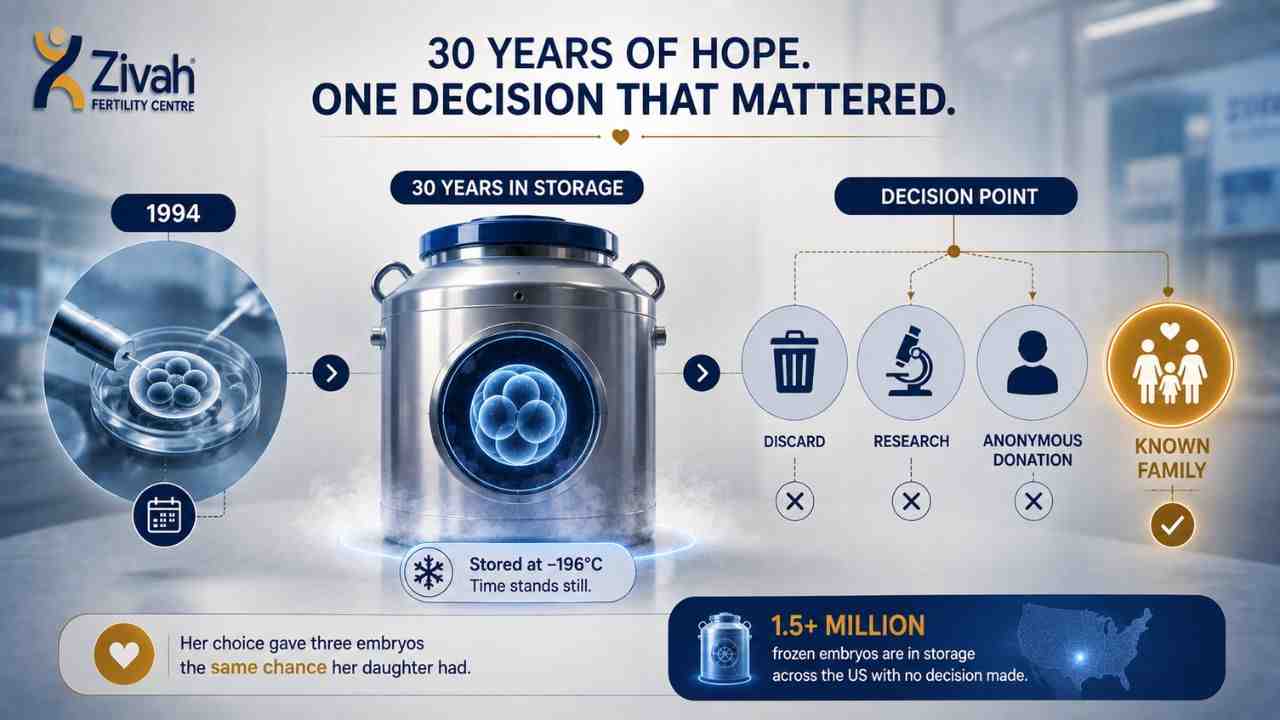
Her reasoning was simple. This was her genetics. These were her daughter's brothers and sisters. She's not the only one in this fork. Most of the 1.5 million frozen embryos in storage across the US have no choice made about them. She has chosen a path that most IVF patients have never heard of, and one that Indian law does not yet allow.
How a 1994 Embryo Found a Family in 2024
Embryo adoption sounds like a strange concept until you learn how it works. Unlike adopting a child, the receiving mother carries the pregnancy herself and gives birth; the baby is genetically unrelated to her, but hers in every other sense.
The difference is choice, which is what makes it different from traditional embryo donation. Both families can state preferences about who they are paired with, and many keep in touch later. In the US, these are mostly faith-based agencies. Archerd’s embryos went through a three-layer system:
- Nightlight Christian Adoptions - the agency
- Snowflakes – its embryo adoption program
- Open Hearts – sub-programme for difficult-to-place embryos
Her embryos were in the last category, and there was a reason for it.
Why Most Clinics Turned These Embryos Away
An embryo from 1994 presents difficulties that are not related to the embryo itself. Old canisters that contemporary laboratories seldom open, a belief that it wouldn’t survive the thaw and absent paperwork from a time before digital records.
That final one almost had it. Archerd sought out the doctor who treated her 30 years ago, still practising in Oregon and now in his sixties, and dug up her paperwork, some of it handwritten. Then the embryos could be shipped from Oregon to Tennessee.
The Couple Who Agreed to Take Any Embryo
By the time Lindsey and Tim Pierce found the programme, they had been trying for seven years and had seen various physicians. When the openness form asked what they would accept, they checked all the boxes. Any age, any storage history, any condition. It’s that one decision that got them paired with embryos that practically any other facility would have passed on.
Then there was logistics: five round flights from Ohio to Tennessee, five hours each, in two weeks. From then on, they’ve been truthful about their motivation. They weren’t looking for a record; they wanted a baby. It was a walk-over. Still, the embryos had to get out of the tank, and 1994 had locked them in something rarely seen in modern labs.
How Can an Embryo Survive 30 Years? The Science Explained
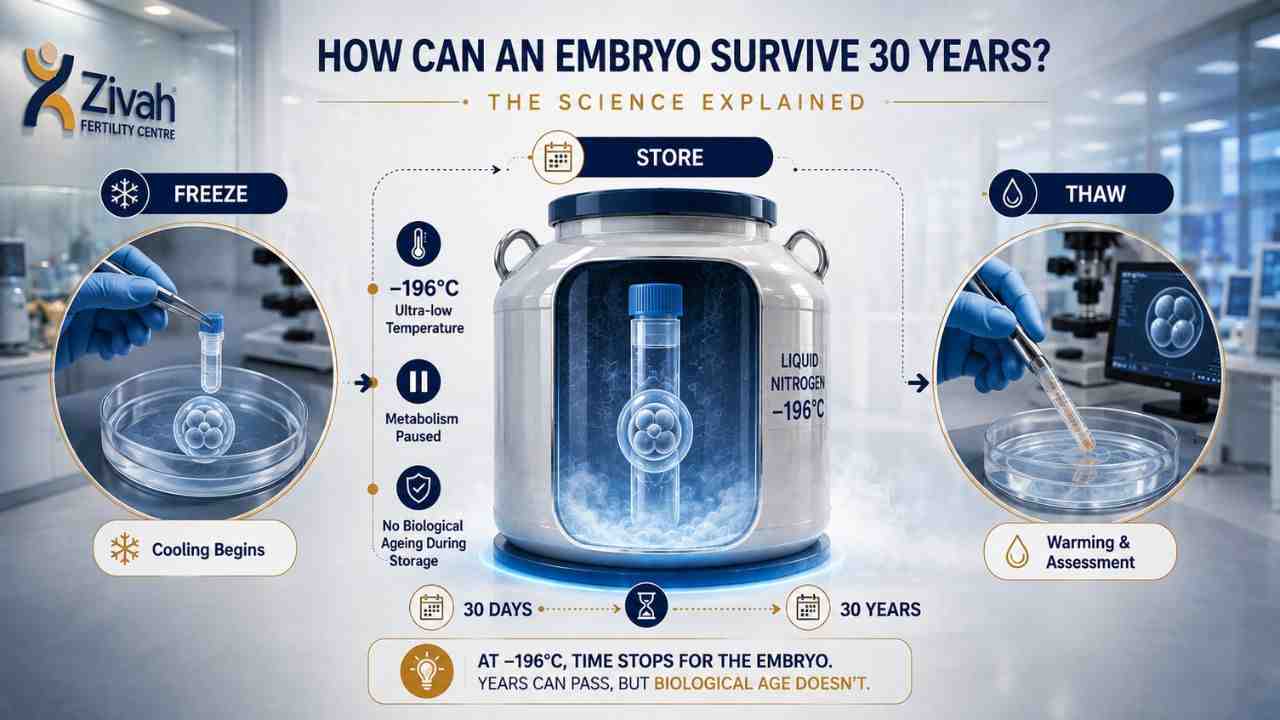
How long can you freeze embryos? At -196°C in liquid nitrogen, all metabolic activity in an embryo stops entirely. The embryo itself doesn't age, whether it rests there for 30 days or 30 years.
The danger of embryo freezing is the freezing and thawing process, not the years in between. To put that temperature in perspective, the coldest spot on Earth is about −90°C. Liquid nitrogen is over twice as cold. That's what makes embryo freezing a real pause button, not a slow descent.
Slow Freezing vs Vitrification: What Changed After 2000
The years are of less importance than the manner of freezing. Slow freezing, the normal practice during the 1990s, dropped the temperature gradually, and when fluid inside the cell froze, sharp ice crystals might develop and destroy it. Vitrification changed all that. It cools so rapidly that the fluid turns glass-like, rather than crystallising.
This is why it is currently used in every modern IVF embryo freezing lab. Thaddeus was of the old school. Not that a cryopreserved embryo lasted 30 years, but that it lasted 30 years frozen the hard way. That is what makes his birth extraordinary.
Does Time in Storage Affect the Embryo or the Baby?
You can read the comforting version here. A Chinese study from 2022 found that storing eggs for longer may make fewer of them survive the thaw, but it didn't have a big effect on the health of babies born.Still other studies found that storage length made no difference at all. The problem is the sample: most of the studies have been on frozen embryos for a few years, not three decades.
Bottom line: The evidence on frozen embryo transfer safety is mixed, and the number of 30-year cases is tiny. Method matters more than duration, yet no result is guaranteed. It’s important to understand where freezing fits in the overall IVF therapy procedure.
Slow Freezing vs Vitrification: How Embryo Freezing Changed
| Feature |
Freezing (pre-2000s) |
Vitrification (used today) |
|---|---|---|
| Freezing speed |
Gradual, over hours |
Near-instant, in seconds |
| Ice crystal risk |
Present, the main cause of damage |
Effectively eliminated |
| Storage container |
Glass or plastic vials, often sealed |
Thin plastic straws |
| Thawing difficulty |
Complex, varies by device |
Standardised, takes seconds |
| Survival after thaw |
Variable |
Consistently high |
| Method used for Thaddeus |
Yes |
No |
The Hardest Part Wasn't the Pregnancy: It Was the Thaw
This is where no one expects it. Lindsey’s pregnancy went smoothly. Taking the embryos out of storage was not. It takes roughly two seconds to thaw a contemporary embryo; you place the straw in some warm solution.
But thawing a 1994 slow-frozen embryo is a different job entirely, using a method most labs stopped teaching years ago. That’s why these embryos took a journey from Oregon to Rejoice Fertility in Tennessee. Not many places know how now.
A Lost Skill: Old Embryos Need Old Knowledge
The technology has been lost in time, says the clinic’s head embryologist. Each of the previous devices was unusual, and they rarely included any instructions. What the job might involve:
- Liquid nitrogen tank with handling forceps
- Opening sealed containers with a diamond-tipped knife
- Understanding how equipment that no one uses works anymore
One heat-sealed glass vial broke and injured her cheek when she opened it. Her goggles protected her eyes, and the embryos survived. The clinic's position is simple: It won't turn away an embryo, no matter how old or how unusual the storage.
What Happened to All Three Embryos
All three of Archerd's embryos are out of the tank. Here's how it played out: One stopped growing after the thaw. Two were transplanted on 14 November; one was inserted. That is the complete result.
One baby out of three embryos. It's important to speak openly, because a frozen embryo transfer is not guaranteed at any age. It was a nice outcome, not a miracle, and the clinic never suggested otherwise. A single birth doesn't change a field. But it does make it check up on assumptions that it stopped asking questions about.
What This Record Changes for IVF and Fertility Science
One example is proof of a possibility. It doesn't show it's likely. Thaddeus proves that a 30-year-old embryo can be transformed into a healthy baby, not that most would.
Experts already expect the record to be broken, as clinics continue to push farther into long-term embryo preservation. What it does modify is the previous concept in reproductive medicine that time in the tank was the limiting constraint.
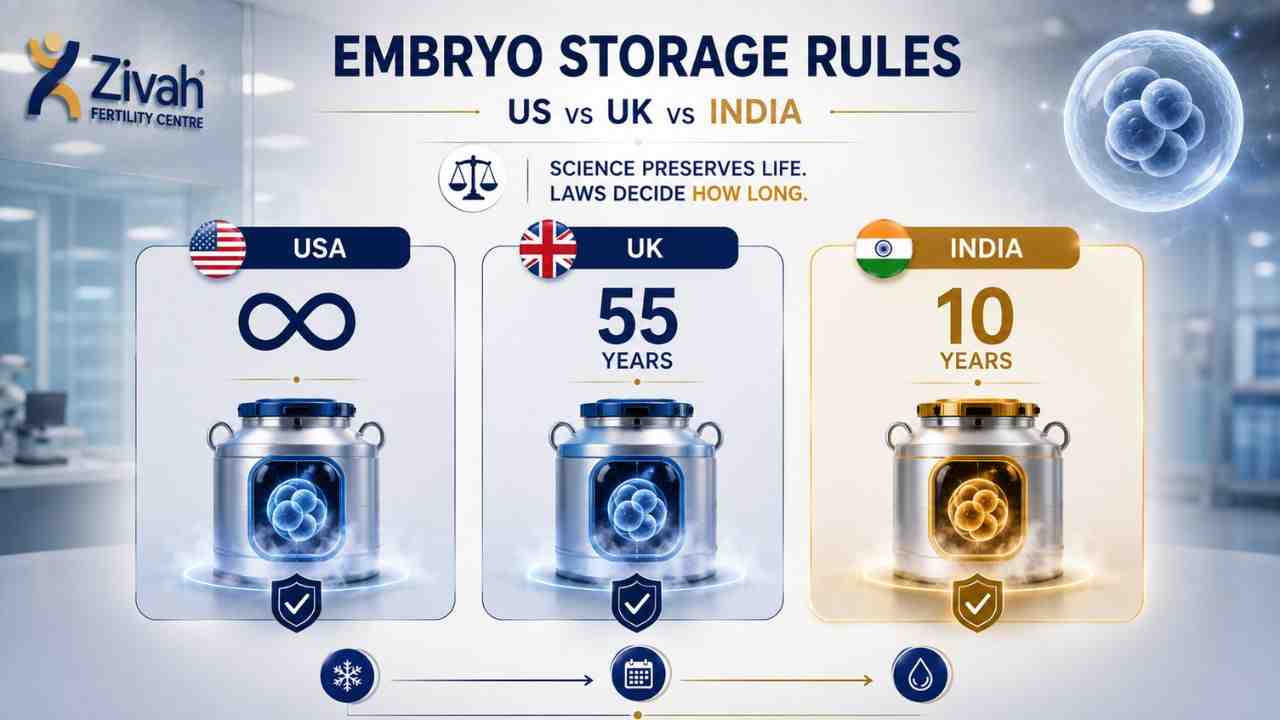
How Long Are Countries Willing to Let Embryos Stay Frozen?
Here is when science has outstripped the law:
- United States – no legal restriction on embryo storage
- United Kingdom – recently increased to up to 55 years
- India – limited at 10 years under the ART Act
Twenty years ago, Indian regulations would have killed Thaddeus's embryo. The argument in reproductive research is really about the gap between the feasible and the permissible.
The Growing Problem of Unused Frozen Embryos
There are over 1.5 million frozen embryos in US storage, most of them undetermined. The reasons include banal reasons, divorce, expired permission, unpaid bills, or families that just can't decide. What happens to unused frozen embryos in India?
- Continued storage – for up to 10 years, under Section 28(2)
- Use in a future frozen embryo transfer - embryos are being held in reserve for the original couple
- Allow termination - the default when storage has ended
- Donate to research - with your written consent
- Donate to another couple - not permitted in India
Linda Archerd didn't take this path here. Altruistic donation of sperm and eggs is allowed in India under the ART (Regulation) Act, 2021; however, there is no legal provision for giving spare embryos to another couple.
The position at the moment is that this provision is challenged and pending, so check with your clinic. The record isn't the narrative if you have embryos in a tank someplace. This is what happens to you.
What This Means If You're Considering Embryo Freezing
Embryo freezing is now routine, rather than a last option, in most IVF cycles. And you wouldn't be frozen as Thaddeus's embryo was frozen. After 2000, slow freezing was replaced with vitrification, or flash freezing, the procedure used at Zivah's embryology lab.
Who Should Think About Freezing Eggs or Embryos?
It is important to talk about fertility preservation if you fall into any of the following categories:
- Beginning cancer treatment that may impact fertility
- Low ovarian reserve, endometriosis
- Have extra embryos from a fresh IVF round
- Are delaying childbearing for whatever reason
Egg freezing is generally the first step if you don't have a partner or donor sperm yet. An FET cycle is easier than a fresh cycle. Your endometrium is timed and primed, the embryo is thawed on transfer day, and the transfer itself is a matter of minutes. Then the two-week wait.
Egg Freezing vs Embryo Freezing: Which Applies to You?
| Question |
Egg Freezing |
Embryo Freezing |
|---|---|---|
| Need a partner or donor sperm? |
No |
Yes |
| Survival after thawing |
Good |
Slightly better |
| If your relationship changes |
Eggs remain yours alone |
Both parties' consent needed |
| Best suited to |
Single women, delaying parenthood |
Couples in active IVF |
| When decided |
Before fertilisation |
After fertilisation |
Whatever you choose now, someone can still be living with your choice decades from now, as one Ohio family knows all too well.
Conclusion
A child is now a healthy toddler, conceived when his mother was four and his father three. That statement doesn't sound genuine. But it is. What his narrative reveals is more complicated than the headlines would have you believe. Time in storage is not the limiting factor that the profession thought an embryo at −196°C waits.
It does not show, however, that any 30-year-old embryo would do the same. One is promise, not possibility. The pregnancy was normal. It was the container of 1994 that almost finished things, opened by someone who still understood how.
And the family never claimed the record. They said it themselves: they just wanted a baby. If you're considering freezing embryos or eggs, the first step is to schedule a fertility preservation consultation with Zivah.