
Perimenopause Symptoms in Women and the Early Signs Many Miss
Aching joints, broken sleep, a shifting cycle. Many perimenopause symptoms get blamed on stress. Here is what to notice and when to see a doctor.

You wake up again at 3 a.m. You're having trouble sleeping, you're not very patient, and your period is coming on its own time. You tell yourself it's stress. This is exactly how many perimenopause signs are missed: they are seen, explained away, and then quietly carried.
Perimenopause is not menopause. It is the stretch of years before it, when your hormones begin to shift. And the early signs of perimenopause are gentle enough to look like everything else.
If you have been wondering Am I in perimenopause, this guide will help you see it clearly. We will look at what changes first, what gets mistaken for something else, and when a change is worth speaking to someone about.
What Is Perimenopause and When Does It Begin?
So what is perimenopause, really? It is the time when your body begins moving towards the end of your reproductive years, slowly and unevenly.
Is perimenopause the same as menopause? No. Menopause is a single day, the day you complete twelve months without a period. Perimenopause is the stretch of years leading up to it, and it can last anywhere from four to ten years.
Here is the part that confuses most women. The main hormone in women, oestrogen, doesn't just fall in a straight line. It moves around. It goes up and down every month, and your body responds to each change. That is why symptoms arrive, settle, and return weeks later.
At What Age Does Perimenopause Start?
For many women, perimenopause starts in the late thirties or early forties. But perimenopause age varies widely, and there is no fixed birthday when it begins.
Can perimenopause start in your 30s? Yes, and more often than most women expect. If your mother reached menopause early, or if you have had certain surgeries or treatments, your own perimenopause may begin sooner. Because early menopause symptoms come and go, it is easy to doubt yourself and wait a little longer than you needed to.
It helps to see where you are in the whole picture.
| Stage | What Is Happening | Typical Age | What You Notice |
|---|---|---|---|
| Perimenopause | Oestrogen rises and falls unevenly | Late 30s to mid 40s | Cycle changes, sleep trouble, mood shifts |
| Menopause | Twelve months since your last period | Around 46-47 in India | Confirmed looking back, not in the moment |
| Postmenopause | Oestrogen settles at a low level | After menopause | Dryness, bone and heart considerations |
Look at the first row. That is where nearly all the confusion lives, because it is the only stage you are living through without knowing it. Menopause is confirmed afterwards. Postmenopause is clear. But perimenopause happens around you, one small change at a time, with nothing to mark its beginning. Which is why knowing the earliest signs matters so much.
What Are the Early Signs of Perimenopause in Women?
The early signs of perimenopause rarely announce themselves. They arrive quietly, one at a time, spread across months. That is why so many women reach their doctor years after the first change, wondering why they waited. Most perimenopause symptoms in women begin with the cycle, then move outward into sleep, mood and energy.
How Do Periods Change in Perimenopause?
Your cycle is usually the first thing to shift. And it often surprises women, because most expect periods to space out, when in fact they tend to come closer together first.
A cycle that has always been 28 days may start arriving at 24 or 25. Bleeding can turn heavier, with more clotting than you are used to. Then a month gets skipped entirely, and the next one returns as though nothing happened.
Are irregular periods always a sign of perimenopause? Not always. Stress, thyroid problems and weight change can all shift your cycle. But when the change settles in and stays for several months, especially alongside perimenopause symptoms at 40 or 45, it is worth taking seriously.
Sleep, Mood and the Symptoms Blamed on Stress
Then come the changes that feel like life, not hormones. You wake at three in the morning with no hot flush to explain it. Anxiety turns up in a woman who has never been anxious. You snap at someone you love and do not recognise yourself.
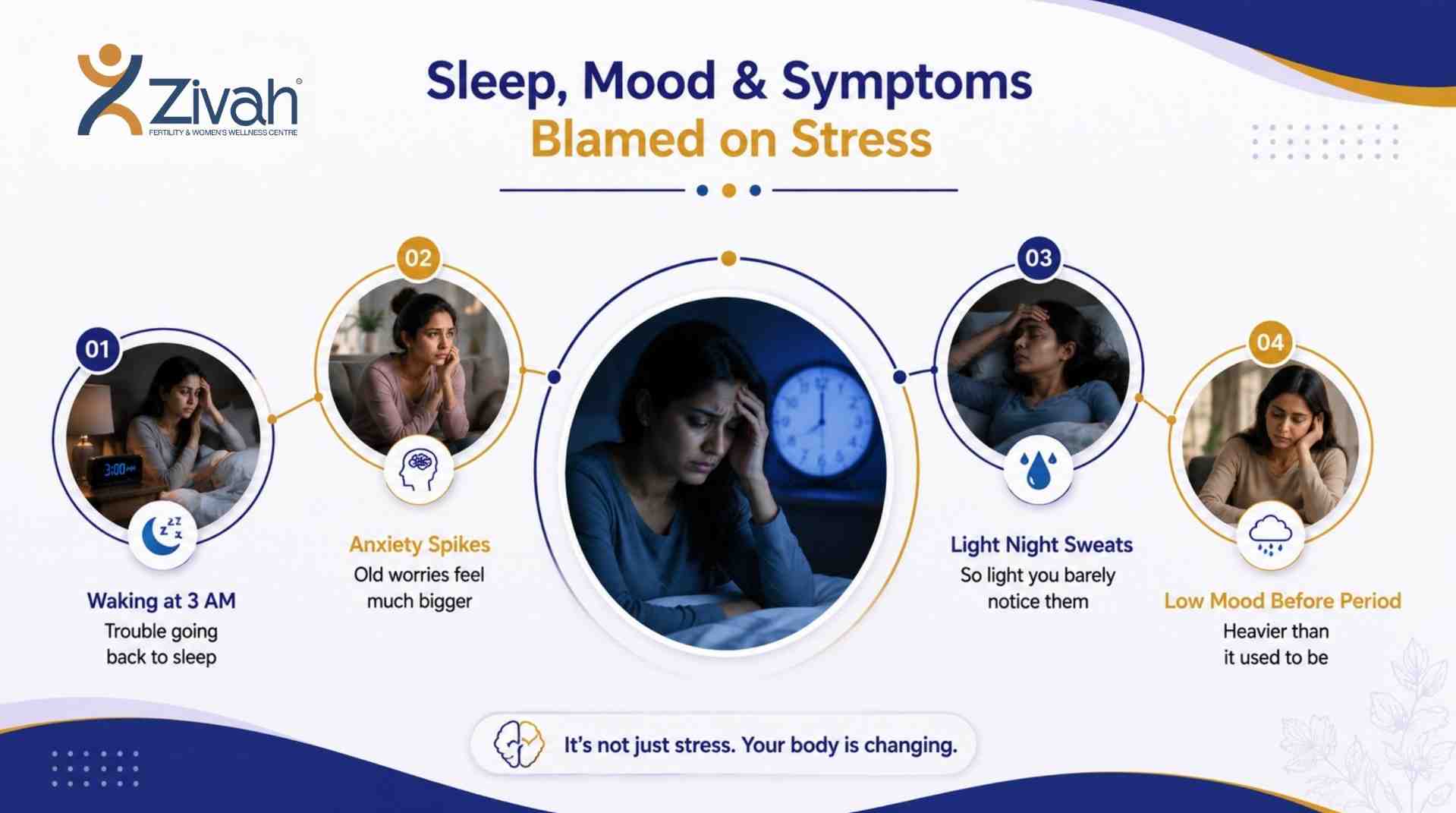
These are the first signs of perimenopause that women most often carry alone:
- Getting up early and having trouble going back to sleep.
- Old worries that suddenly feel much bigger than they did.
- Night sweats so light you barely register them.
- Low mood in the days before your period, heavier than it used to be.
Each one has an easy explanation: work, children, poor sleep, a difficult month, which is exactly why perimenopause anxiety and perimenopause insomnia go unrecognised for so long. Some symptoms, though, are missed even more completely.
Perimenopause Symptoms Many Women Miss Completely
Ask most women what perimenopause looks like, and they will say hot flushes (also called hot flashes). But a full perimenopause symptoms list reaches much further, into places you would never think to connect.
What Physical Symptoms Does Perimenopause Cause?
Your joints ache in the morning. Your heart flutters while you sit still. Your skin turns itchy, your hair feels thinner, and perimenopause fatigue settles in, the kind sleep does not fix. Perimenopause weight gain gathers around the middle, even when your eating has not changed.
Can perimenopause cause joint pain and heart palpitations? Yes. Oestrogen receptors sit in your joints, skin and heart tissue, so falling levels are felt far beyond your reproductive system.
Can Perimenopause Affect Your Memory and Mood?
It can, and this is the part women find hardest to say aloud. Perimenopause brain fog is real. You walk into a room and forget why. A word slips away mid-sentence. Perimenopause memory loss of this kind is common and usually temporary. Many women also notice a quieter libido and tears that arrive without a reason. Every one of these has an easier explanation waiting.
| Symptom | Commonly Blamed On | Why It May Be Perimenopause |
|---|---|---|
| Waking at 3am | Stress, overthinking | Falling oestrogen disturbs sleep |
| New anxiety or low mood | Work pressure, family load | Hormone swings affect mood chemistry |
| Aching knees, hips, fingers | Ageing, weight, exercise | Oestrogen supports joint tissue |
| Forgetfulness, losing words | Tiredness, busy mind | Oestrogen affects memory and focus |
| Weight settling at the middle | Diet, less activity | Fat distribution shifts as oestrogen falls |
| Heavier or shorter cycles | Diet, stress, thyroid | Often the very first perimenopause sign |
| Hot flushes and night sweats | Weather, spicy food | Classic but often arrives later than expected |
| Palpitations | Anxiety, caffeine | Common and usually harmless in this phase |
Read the middle column again. Every explanation there is reasonable, and on any given day it may be the right one. What matters is the pattern: one symptom is a bad week; four arriving together and staying for months is something else. For many women in India, that pattern begins earlier than expected.
Why Perimenopause Starts Earlier in Indian Women
Most of what you read online about perimenopause was not written for you. It assumes menopause arrives around 51, and that perimenopause begins somewhere in the mid-forties.
Indian research has consistently found something different. Women in India reach menopause on average around 46 to 47, several years earlier than the global figure. And since perimenopause can begin eight to ten years before that final period, the real starting point for many Indian women falls in their late thirties.
Can perimenopause begin in your late thirties? Yes, and among Indian women, it is common, which is exactly why the symptoms get dismissed.
What Is the Average Menopause Age in India?
Around 46 to 47 years, though it varies from woman to woman. Research from Indian institutions has consistently reported figures in this range across different regions.
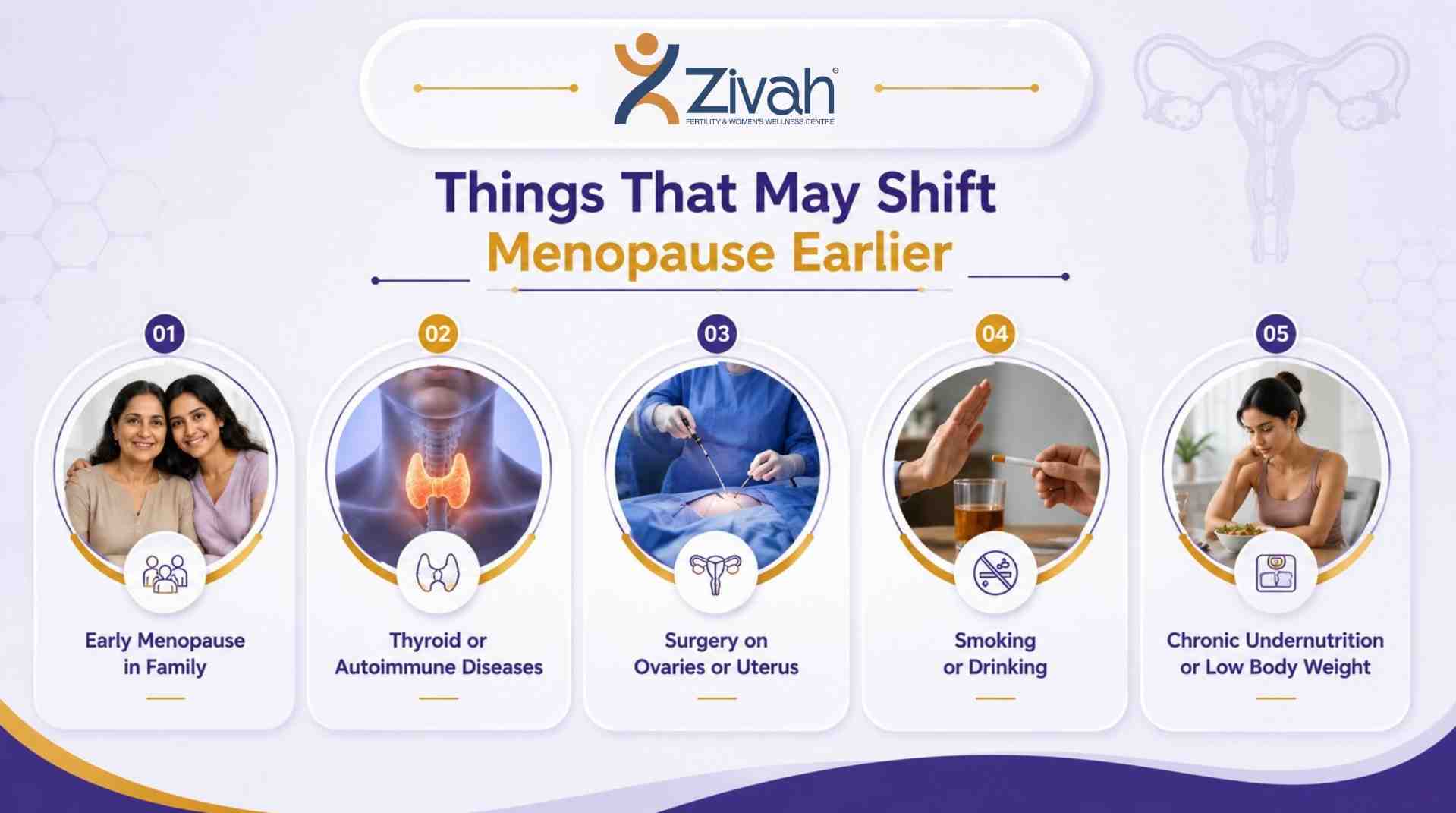
Several things may shift that age earlier for an individual woman:
- A mother or sister who went through menopause early.
- Thyroid or autoimmune diseases that last a long time.
- Having surgery on the ovaries or uterus.
- Smoking or drinking.
- Chronic lack of food or a very low body weight.
None of these decides anything on its own. They make it more likely that your own timeline runs ahead of the average.
Here is the practical risk. A woman of 38 with broken sleep and cycles that keep shifting looks at the age ranges online, decides she is far too young for this to be hormonal, and waits. She may wait three or four more years before anyone connects her perimenopause symptoms to hormones at all. You do not need to be a certain age to notice a change in your own body.
Though noticing it does raise a fair question: is this perimenopause, or is it something else?
What Else Could It Be? Conditions That Look Like Perimenopause
Here is something worth saying honestly. Not every symptom in this guide belongs to perimenopause.
Tiredness, low mood, weight change and an unsettled cycle appear in several conditions common among Indian women. Thyroid disorder is the closest match, so close that perimenopause or thyroid is one of the questions women ask most, and one a hormonal health check can usually settle quickly.
How Do You Know If It Is Perimenopause or Thyroid?
You often cannot tell from symptoms alone. When women compare thyroid symptoms vs menopause, the overlap is almost complete: fatigue, mood change, weight shifting, irregular cycles. The difference is that a thyroid problem is confirmed with one simple blood test. Perimenopause is not.
Is there a test that confirms perimenopause? Not a reliable one. Your hormone levels swing so widely week to week that a single FSH test can read normal one month and abnormal the next. A perimenopause test is more useful for ruling other things out.
Which is why your doctor may check a few things first.
| Condition | Overlapping Symptoms | What Sets It Apart |
|---|---|---|
| Thyroid disorder | Fatigue, mood change, weight shift, irregular cycles | Confirmed by a simple blood test |
| Iron-deficiency anaemia | Tiredness, breathlessness, hair fall | Very common alongside heavy periods |
| Vitamin D deficiency | Joint ache, low mood, poor sleep | Widespread among Indian women |
| PCOS | Irregular cycles, weight change | Usually present since early adulthood |
| Depression or anxiety | Low mood, poor sleep, low libido | No cycle change alongside it |
None of this is meant to talk you out of perimenopause. If you are in your late thirties or forties and your cycle is shifting, it remains the most likely explanation.
But two things can be true at once. Many women turn out to be perimenopausal and low in iron, or perimenopausal with an underactive thyroid. Treating one often lifts more than you expected. Which brings up a question that surprises women more than most.
Can You Still Get Pregnant During Perimenopause?
Yes, you can. And this surprises women more than almost anything else about this stage. Perimenopause is not the same as being infertile. Your fertility falls, but it does not switch off.
Ovulation turns unpredictable rather than absent. Some months your body releases an egg, some months it does not, and there is no way to know which kind of month you are having.
So pregnancy remains possible for as long as your periods still arrive, however irregular they have become.
How long should you continue contraception? Until you are certain. Specialists generally advise one year after your last period if you are over 50, and two years if you are under 50. A few skipped months is not the same as being finished.
If you are hoping to conceive instead, that same unpredictability is worth discussing with a specialist sooner rather than later. Much of what comes next is about how you look after yourself day to day.
How to Manage Perimenopause Symptoms Day to Day
You cannot stop perimenopause. But a great deal of perimenopause symptom relief comes from ordinary habits, practised steadily.
What Helps With Perimenopause Symptoms Naturally?
Small changes carry surprising weight here:
- Twice a week, strength training is good for your bones, muscles, and mood.
- Protein at every meal, not only at dinner.
- Calcium and vitamin D, which many Indian women fall short on.
- Less caffeine after lunch, less alcohol in the evening.
- For night sweats, cotton layers and a cooler bedroom are best.
Do perimenopause supplements actually help? Only for what you are short of. Calcium and vitamin D are worth discussing with your doctor. Most others promise more than they deliver. A steady perimenopause diet and regular movement will do more than any single remedy.
When Should You See a Doctor About Perimenopause?
When symptoms start shaping your days rather than passing through them, broken sleep for months, a mood that worries you, or flushes that interrupt your work all deserve a conversation.
Perimenopause treatment exists, and it suits most women. What is right for you depends on your health history, which is why it belongs with a specialist rather than a search bar. Zivah's women's health team can talk you through your options.
| Change | Helps With | Why It Works |
|---|---|---|
| Strength training twice weekly | Bone strength, joint ache, mood | Protects what oestrogen once supported |
| Protein at every meal | Energy, muscle, appetite | Supports muscle as oestrogen falls |
| Less caffeine after midday | Sleep, palpitations, flushes | Reduces night-time disturbance |
| Cotton layers and a cool room | Night sweats | Simple, immediate relief |
| Tracking your cycle and symptoms | Clarity at your appointment | Turns a vague worry into a clear pattern |
You don't have to change everything at once. Pick one row and hold it for a month, and watch what changes. For most women, sleep gets better first, and then a lot of other things get better too. But some changes should happen right away, not in a month.
Signs That Need a Doctor's Attention
Most perimenopause symptoms can wait for your next appointment. A few cannot.
Is heavy bleeding a normal part of perimenopause? Heavier periods are common, yes. But bleeding that soaks through protection every hour, runs beyond seven days, or arrives between cycles is not something to wait out.
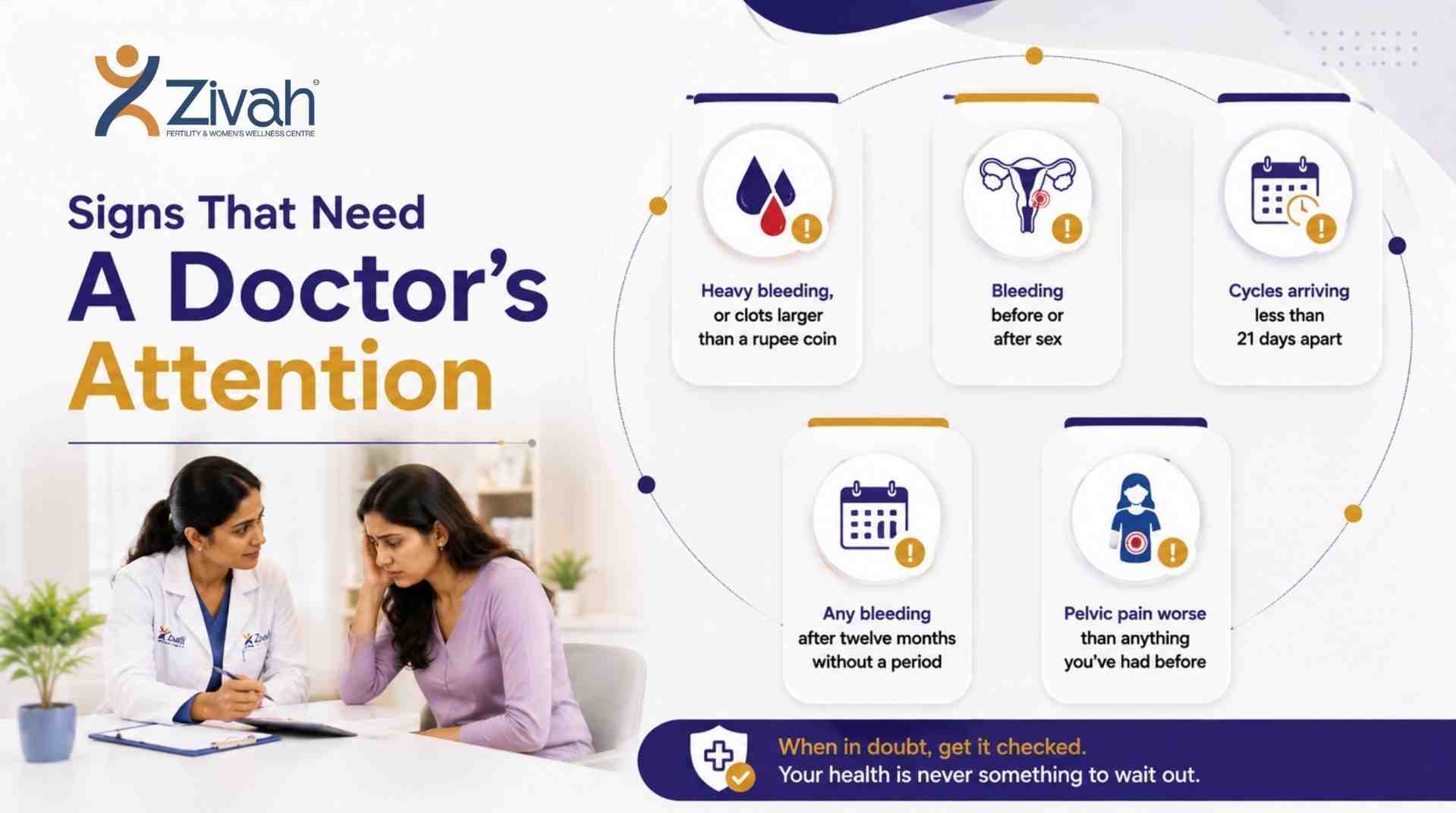
Please see a doctor if you notice:
- Heavy bleeding, or clots larger than a rupee coin
- Bleeding before or after sex
- Cycles arriving less than 21 days apart
- Any bleeding after twelve months without a period
- Pelvic pain worse than anything you've had before
Fibroids, polyps or hormone shifts usually explain abnormal bleeding in perimenopause. But each needs a look rather than an assumption. Keeping up your routine health checks matters here too; noticing a change early applies to your whole body, not only your cycle.
| What to Track | How to Record It | Why It Helps Your Doctor |
|---|---|---|
| Cycle length | First day of bleeding each month, for three months | Shows whether cycles are shortening, lengthening or skipping |
| Bleeding pattern | Days of bleeding, how heavy, any clotting | Separates ordinary change from bleeding that needs review |
| Sleep | Nights you wake, and roughly what time | Night waking is often the earliest measurable sign |
| Physical changes | Flushes, joint ache, palpitations, headaches | Builds a pattern rather than a list of isolated complaints |
| Mood and focus | Days of low mood, anxiety, brain fog | Links emotional changes to your cycle |
Three months of simple notes turn a ten-minute appointment into a useful one. You arrive with a pattern rather than a worry. Perimenopause is a passage, not a permanent state.
Key Takeaways
- Perimenopause is the years before menopause, when oestrogen swings rather than steadily falls, which is why symptoms come and go.
- Your cycle usually changes first, often arriving closer together before it spaces out.
- Joint pain, brain fog, palpitations and weight gain are perimenopause symptoms too, and are easily blamed on stress or ageing.
- Indian women reach menopause around 46 to 47, so perimenopause often begins in the late thirties.
- Heavy bleeding, bleeding between periods, or any bleeding after twelve period-free months needs review, not patience.
Conclusion
If you have read this far, something in it probably felt familiar. Because the hardest part of perimenopause is rarely the symptoms themselves; it is the years spent wondering what is wrong with you, when nothing is wrong at all.
Your body is doing something ordinary. It does it quietly, and without telling you first.
So notice what changes. Write a little of it down. And when something does not sit right, speak to someone who understands this stage properly rather than searching alone at midnight.
Zivah's women's health team is here whenever you are ready to talk it through. You are not too young for this, and you are not imagining it.
Frequently asked
01 How long does perimenopause last?
02 Can perimenopause start at 38?
03 What are the first signs of perimenopause?
04 Can perimenopause cause anxiety and panic attacks?
05 Does perimenopause cause weight gain?
06 Can perimenopause affect your periods without other symptoms?
07 Can perimenopause cause hair loss?
08 Why do I wake up at 3am during perimenopause?
09 Do perimenopause symptoms come and go?
10 How do I know perimenopause has ended?