
What Are the Early Breast Cancer Symptoms Every Woman Should Know?
Noticing a lump, skin change or nipple discharge? Learn the early breast cancer symptoms every woman should know, lump, and when to see a doctor.

Many early breast cancer symptoms in women are painless. That's where people make mistakes. Usually, early breast cancer signs are modest: a lump that doesn't hurt, a slight change in the skin, a nipple that sits differently than before. So they become filed away as hormonal, or normal, or something that will get over.
In this guide, we discuss what an early lump truly feels like, signs of breast cancer in women that present without a lump at all, how symptoms change throughout stages, and how to perform a self-check at home. Many women don't find a lump first.
What Are the Early Signs of Breast Cancer in Women?
Early breast cancer rarely causes any symptoms. No pain, no hurry, simply a slight change. Early signs of breast cancer you should take action on:
- New – not something you always have
- One-sided – not like your other breast
- Persistent - remains present after two to three weeks
If it goes on for more than one cycle, it's not hormonal. There are two types of Breast cancer warning signs: things other people can see, like dimpling or an inverted nipple, and things only you can feel. Most breast changes are not cancer. What do women notice first?
What Is Usually the First Sign of Breast Cancer in Women?
In women, the first sign of breast cancer is often a new lump or thickening in the breast or armpit. It feels harder than the surrounding tissue and is rarely painful. But not all the time.
For many women, the first symptom of breast cancer is a skin change or a twisted nipple. For others, there is nothing there, it is caught on a normal mammogram. A normal mammography months ago does not exclude a change you experience now. So where do you look?
4 Early Signs of Breast Cancer Every Woman Should Recognise
Most breast cancer symptoms happen in one of four sites. Half of it is where to look; the other half is how you look. Stand in front of a mirror in 3 different ways:
- Arms down - baseline shape
- Hands on hips, pressed - tightens the chest wall and reveals pulling
- Arms overhead - demonstrates contour alterations concealed behind
A dimple you couldn't see with your arms down might pop out the second you raise your arms, which is why one position isn't enough.
The Four Places to Check for Early Breast Cancer Signs
| Where to Check |
What to Look or Feel For |
Why It Matters |
|---|---|---|
| Breast tissue |
New lump or thickening; firm, irregular, usually painless |
Most commonly noticed first sign |
| Breast shape & skin |
New asymmetry, contour change, dimpling, orange-peel texture |
Visible before it is palpable |
| Nipple & areola |
New inversion, flattening, crusting, discharge |
New change matters, not lifelong shape |
| Underarm & collarbone |
Swelling, firm node, persistent fullness |
Can appear with no breast symptom |
Breast Cancer and Lumps: What Does a Breast Cancer Lump Actually Feel Like?
Press anyplace on your chest, and you'll feel something. Breast tissue is inherently rough and bumpy, so the question was never whether you felt something; it's which textures are important.
A classic breast cancer lump is hard, doesn't move, has irregular edges, is usually not painful and doesn't change with your cycle. These are the first features physicians look for in a breast cancer lump. But cancerous tumours might be soft, spherical, or painful, thus texture alone never provides the answer. It makes a big difference to know how to check properly.
How to Identify a Breast Lump at Home
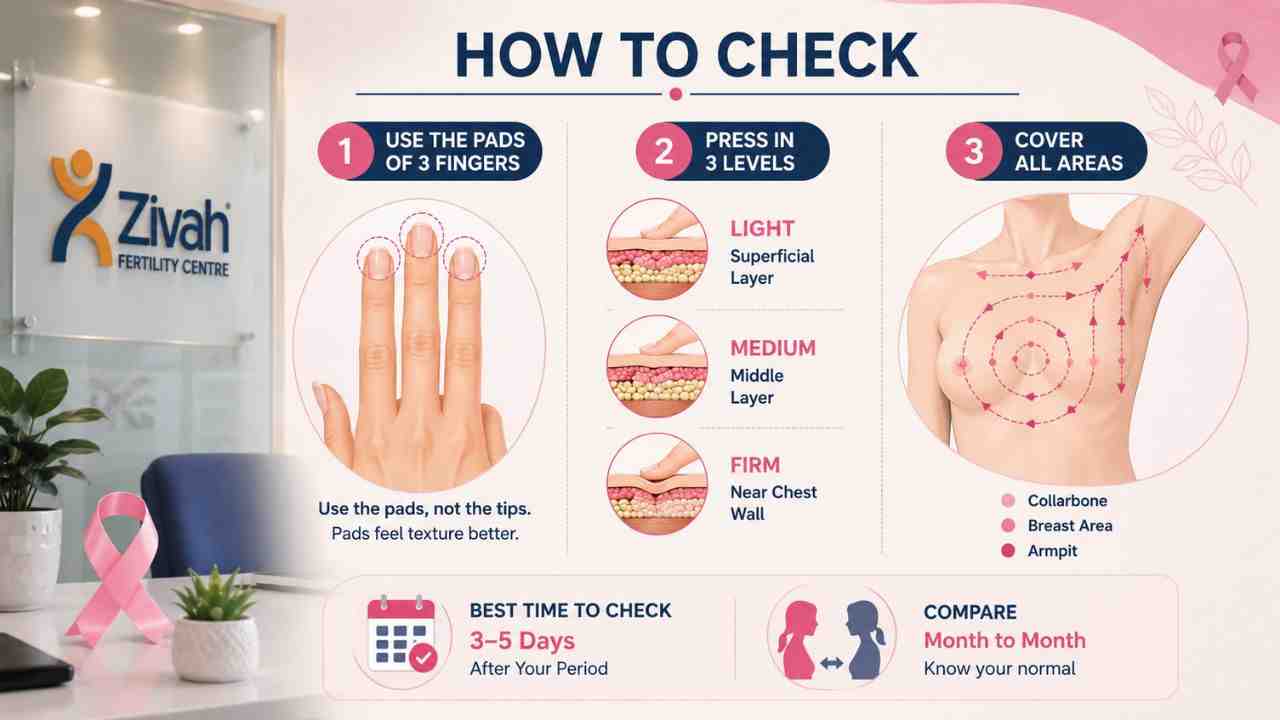
Use the pads of your fingers, not the tips, because pads read texture significantly better. Press three times in the same location, softly for the superficial tissue, medium for the intermediate layer, then strongly for tissue resting near the chest wall. Spread it all over from your collarbone down to your bra line and from your breastbone over to your armpit.
Schedule three to five days after your period finishes, when the tissue is least swollen, or set a regular monthly date after menopause. Then compare how you feel to your other breast and to the previous month.
Can a Breast Lump Be Painful, Tender, or Move Around?
Yes to all three. Most lumps that act this way turn out to be benign. Cysts and fibroadenomas are usually slippery and pebble-like, moving away as you press on them, whereas a more worrisome lump feels attached to something below it. Lumps that come and go with your cycle are generally hormonal; therefore, a lump that comes and goes is not normally the concerning type.
The other is a lump that hangs there during the whole cycle and doesn't change. So here's a simple guideline to carry: persistence over texture. Side note: in contrast, a standard doesn't matter much.
Is a Lump on One Side Only More Concerning?
Your left breast is neither more nor less concerned than your right breast. There is no difference in danger between left and right. Asymmetry is what counts, something on one side not balanced by something on the other. However, deep, crushing or radiating pain in the left chest is a heart problem, not a breast problem, and needs emergency attention.
Breast Cancer Symptoms Other Than Lumps Women Often Ignore
The most harmful breast awareness myth is that no lump = no cancer. It doesn't. Many breast cancers never develop a lump you can feel, and this is often the case with inflammatory breast cancer.
Instead, these tumours proclaim themselves through the skin, the nipple, and the contour of the breast. Which means that self-awareness has a second part that most women skip: You have to look, not just feel. This will likely be ignored.
Overlooked Breast Changes That Are Often Mistaken for Something Harmless
| Overlooked Change |
Commonly Mistaken For |
Why It Needs Evaluation |
|---|---|---|
| Linear skin tethering or puckering |
Stretch marks, ageing skin |
Underlying tissue pulling on Cooper's ligaments |
| Persistent one-sided warmth and redness |
Mastitis, insect bite, allergy |
Possible inflammatory breast cancer |
| Scaly, crusting, non-healing nipple |
Eczema, dryness, friction |
Possible Paget's disease of the breast |
| Spontaneous discharge from one nipple |
Hormonal change, squeezing |
Bloody or clear, unsqueezed, one side, needs review |
| Recent, new breast asymmetry |
Normal variation, bra fit |
New asymmetry is different from lifelong asymmetry |
Skin Changes on the Breast: Dimpling, Rash and "Stretch Mark" Confusion
Regular stretch marks are not a symptom of breast cancer. Striae are parallel rips in the deeper skin from rapid volume change, puberty, pregnancy, weight increase or decrease and are quite frequent.
What women who are looking for a cancerous stretch mark on the breast are frequently seeing is something else: linear skin tethering, where tissue under it pulls on the internal support ligaments of the breast and pulls the skin inward. It seems like a line, but it's a shift in shape, not colour.
That is the distinction to hang on to. Stretch marks are flat and will vanish with time. Changes to the texture of the skin: tugging, thickening, dimpling or a sore that won't heal. If you have a shifting mole or chronic lesion on the skin itself, it is a dermatological question, not one of breast tissue. But skin is just half the story. The other one is the nipple.
Nipple Changes and Discharge as Warning Signs of Breast Cancer
Are flat nipples a sign of breast cancer? Usually not, around one in five women have naturally flat or inverted nipples. If yours have always sat like that, that's just the way your body is made. What counts is if the change is new. Notice the nipple that suddenly tucks in, flattens, or points somewhere else. Discharge when it is a concern:
- From a single breast
- Spontaneous – not caused by squeezing
- Not milky, bloody or clear
Milky discharge out of breastfeeding is frequently hormonal but worth checking. Breast nipple pain alone is seldom cancerous, but it can change with crusting. A single illness breaches every guideline listed above.
Inflammatory Breast Cancer Symptoms Without a Lump
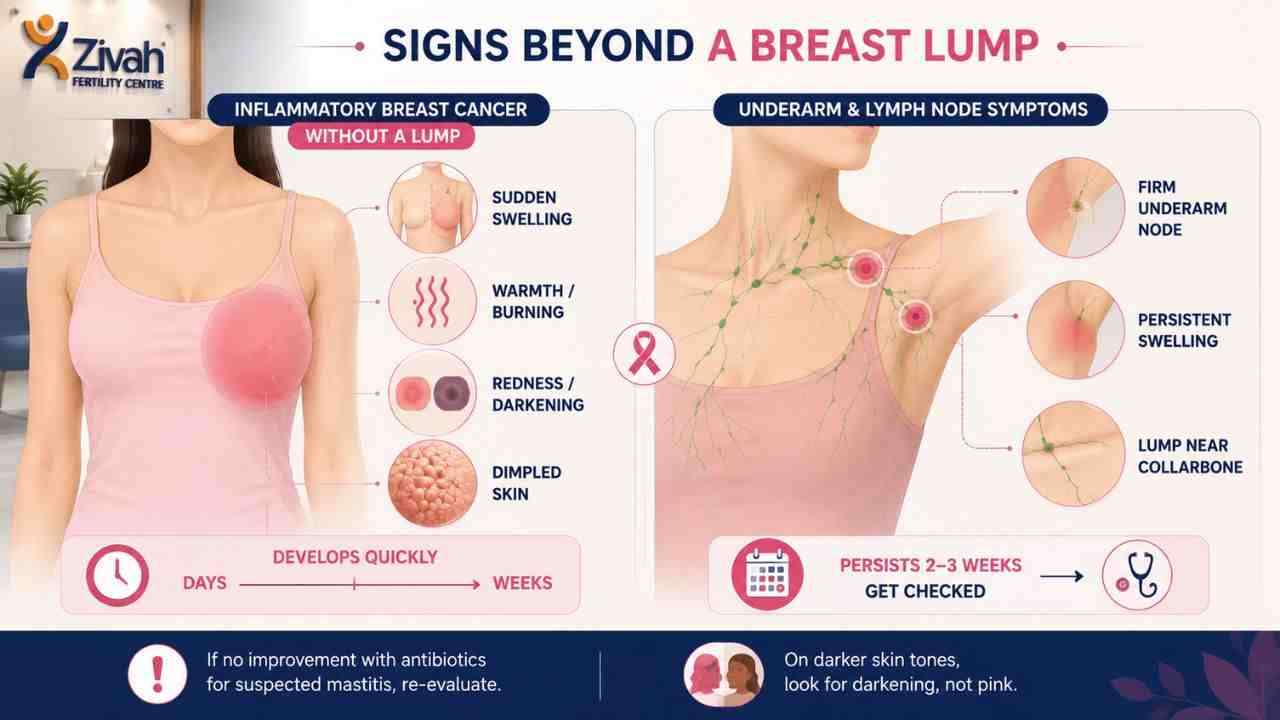
Inflammatory Breast Cancer is rare, aggressive, and often confused with infection. Usually no lump occurs at all. Be careful of:
- One breast suddenly grows bigger
- Warmth, itching, or burning sensation
- Redness or purple colour on one-third of the breast
- Dimpled, orange-peel-like skin
The giveaway is speed, these inflammatory breast cancer symptoms grow within days and weeks, not months. If antibiotics for suspected mastitis don't clear it, re-evaluate rather than restart the course. On darker skin tones, look for darkening, not pink. Other symptoms are not even close to the breast.
Underarm and Lymph Node Symptoms of Breast Cancer
Some women don't feel anything in the breast. The first thing they see is under the arm. That’s not by accident. Since breast tissue drains into the lymph nodes of the armpit first, signs of underarm breast cancer might be present before anything shows up in the breast itself. What to watch for:
- A detached node or a firm lump in the axilla
- Tenderness or ongoing swelling
- A lump above the breast, under the collar bone
Infections, recent vaccination, and skin injury also cause nodes to swell. It’s the persistence beyond two to three weeks that is the trigger, that’s when breast lymph node cancer symptoms need examination. This is the fourth item in our table above, and the one most women skip.
Does Breast Cancer Hurt? Breast Pain and Arm Pain Explained
Most of the women wondering if breast cancer hurts are asking because they have pain already. So the quick answer first: Early breast cancer is generally painless. Regular breast pain is hormone-related. Both breasts, stretched out rather than fixed, worse in the days before your period that’s tissue reacting to your cycle.
Breast tumour symptoms are the other way round. Pain is a concern in:
- One stable point
- Only one side
- No connection to your cycle
- Same old same old week after week
What does breast cancer shoulder pain feel like? Arm and shoulder discomfort is generally muscular, but unexplained pain that persists and is associated with a change in the breast or underarm is important.
Does Breast Cancer Make You Tired? Fatigue as a Symptom
Fatigue is not an early symptom of breast cancer. Fatigue in breast cancer is frequently due to more advanced or metastatic illness, often with symptoms of bone pain, dyspnea or unexplained weight loss.
More likely reasons for common weariness include anaemia, thyroid problems, iron deficiency, and stress. Still, unexplained persistent tiredness is worthy of a visit, just not a breast-cancer-first one.
Breast Cancer Symptoms by Stage: Stage 1 to Stage 4
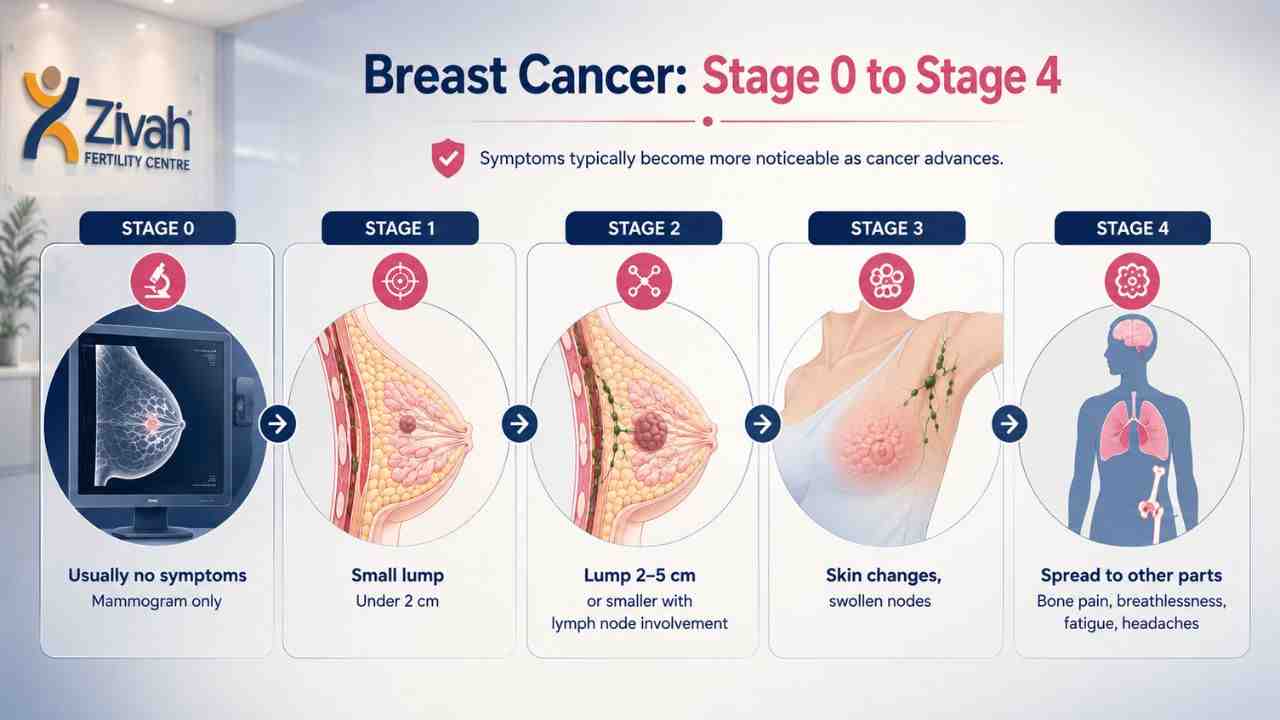
Breast cancer symptoms at various stages are based on three things: the size of the tumour, whether it involves the skin, and whether it has spread to the lymph nodes. As each of those increases, the symptoms become easier to notice, which is the exact issue.
Stage 1: Breast cancer frequently has no signs or symptoms, and Stage 0 usually produces none. And that’s the point of screening: the quietest phases are the most treatable.
Stage 2 breast cancer symptoms are where most people first discover something themselves, generally a lump they can feel. Skin changes are later in the sequence. Fatigue later on. The best outcomes are when breast cancer is detected before it spreads.
How Breast Cancer Symptoms Change from Stage 0 to Stage 4
| Stage |
Typical Symptoms |
How It Is Usually Found |
|---|---|---|
| Stage 0 (DCIS) |
Usually none, cancer confined to the milk ducts |
Mammogram only |
| Stage 1 |
Small lump under 2 cm, often painless; skin and nipple normal |
Mammogram or clinical breast exam |
| Stage 2 |
Lump 2–5 cm, or smaller with lymph node involvement |
Often self-noticed |
| Stage 3 |
Larger tumour, visible skin and nipple changes, swollen nodes |
Symptom-driven |
| Stage 4 (Metastatic) |
Bone pain, breathlessness, persistent fatigue, headaches |
Symptom-driven plus imaging |
Look how much of the left column is vacant early. That is why it is more important to know your own breasts than to wait for a symptom to show up.
How to Check If You Have Breast Cancer: Breast Self-Examination Steps
How to know if you have breast cancer at home? You can't, but you can understand what is usual for you, and that's how a change stands out. That's why doctors these days talk about breast self-awareness rather than breast self-examination. Here's the breast self-exam in 3 steps:
- Look – mirror, arms down, hands on hips, arms up
- Feel standing - in the shower works well
- Feel lying down - tissue spreads flat, easier to read
Pick any of the one pattern: circular, vertical strip, or wedge. Repeat the same every month. Technique is beaten by consistency. Always show your collarbone and armpit.
If you find something unusual, write down which breast, where, when you first saw it and if it changes with your cycle. Self-exams don't prevent cancer or replace screening. They're changes you can see. If yours raises a query, a clinical breast exam at Zivah is the correct next step. But what if there is nothing there?
What If You Have No Symptoms at All? Screening and Dense Breasts
Is it possible to have breast cancer and not be aware of it? Yeah. Early cancers in populations screened are usually diagnosed before symptoms develop, that's the point of breast cancer screening. Dense breast tissue makes this twice as complicated.
It adds danger. And it conceals. Both thick tissue and tumours appear white on a mammogram, so one might mask the other. That's why a breast ultrasound is commonly included for women with thick breasts and for younger women, where density is more common.
Who Should Be More Alert to Breast Cancer Symptoms?
Some women have more risk factors for breast cancer than others:
- Family history of breast or ovarian cancer
- A known alteration in the BRCA1 or BRCA2 gene
- Breasts that are thick or have had breast cancer
- Early first period, late menopause
- First pregnancy beyond 30 years old or no pregnancy
- Alcohol, obesity or prior chest radiation
One thing to say is the majority of women diagnosed do not have a family history at all. Risk factors aren't a determiner of who gets it; they sharpen your attentiveness.
Why Indian Women Should Watch for Breast Cancer Symptoms Earlier
Much of the screening information you see online is focused on age 40 and intended for Western populations. Indian women had a lower mean age upon presentation with breast cancer. The practical risk is a woman in her early thirties recognising a true shift and discounting it because she thinks she's too young to count.
So think of self-awareness as something that begins in your twenties. Talk with your doctor about when to start official screening, earlier if breast cancer runs in your family.
Breast Evaluation Options and When Each One Is Advised
| Test |
What It Does Typically Advised |
When |
|---|---|---|
| Clinical breast examination |
Physical assessment by a clinician |
Any new breast change; routine well-woman visits |
| Breast ultrasound |
Characterises lumps; performs better in dense tissue |
Dense breasts, younger women, evaluating a lump |
| Mammogram |
Screening and diagnostic imaging |
Routine screening from 40; earlier with risk factors |
| Breast biopsy |
Confirms whether cells are cancerous |
When imaging identifies a suspicious area |
At Zivah, Siliguri, we provide clinical breast examination, high-resolution breast ultrasonography, bilateral mammography and BRCA gene testing. If a biopsy is indicated, our staff facilitates referral with approved partners.
Breast Cancer Treatment Options: A Brief Overview
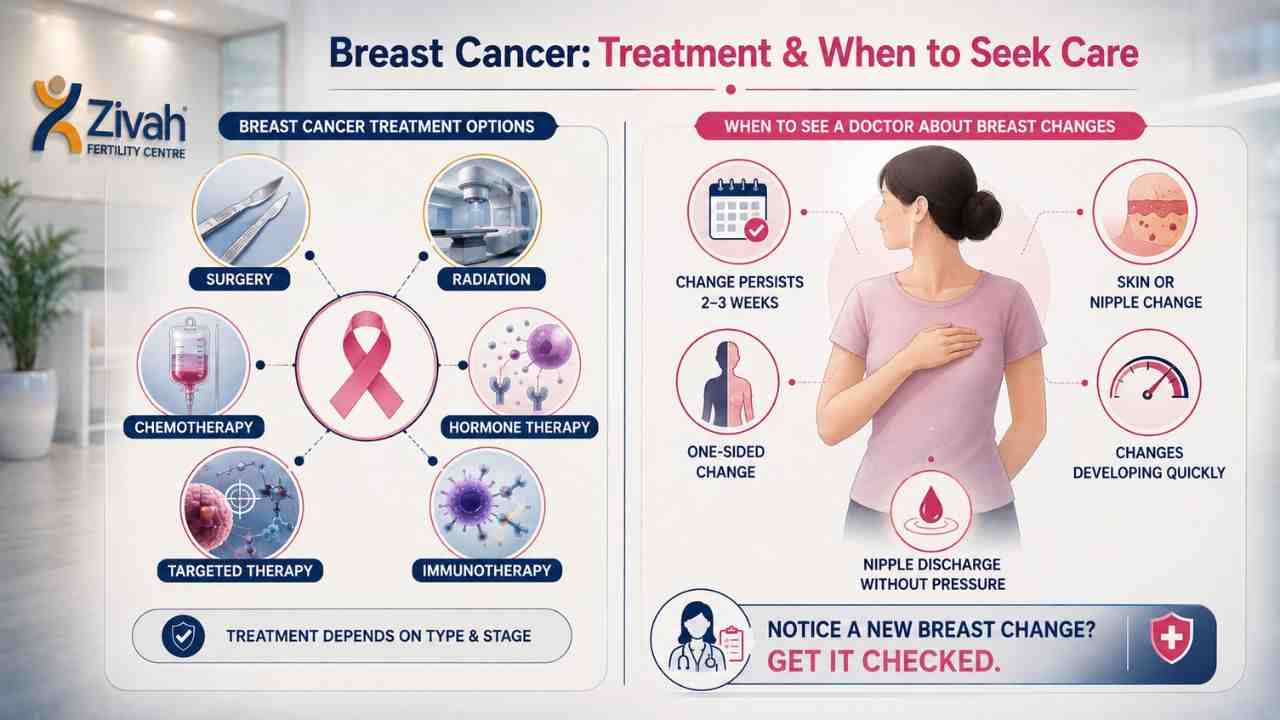
Breast cancer treatment depends on your type and stage of cancer, and your health. Possible options are surgery (a breast cancer procedure may be a lumpectomy or mastectomy), radiation, chemotherapy, hormone treatment, targeted therapy, and immunotherapy. Found early, there are more of these left accessible to you.
When Should You See a Doctor About Breast Symptoms?
See a doctor about breast changes if any of the following apply:
- After two or three weeks, there is yet one more change
- Anything on one side only
- Any change in the look of skin or nipple
- Anything moving fast
- Spontaneous nipple discharge
The two things that keep women from attending are shyness and "it's probably nothing." No medical need to wait; either one symptom is good. You need just one or two. For a women's health consultation, clinical breast examination, or breast ultrasound evaluation, Zivah's team in Siliguri can help.
CONCLUSION
Three things to take away from this guide. Feel for a lump, and remember texture is less important than persistence. Check yourself in the mirror for changes in your skin and nipples before you can feel them. Notice what's going on in the underarm region, the spot most ladies miss.
There is one guideline that covers all: if it is fresh on one side and it is still there after two to three weeks, have it checked. Most breast changes are not cancer.
Checking is not panicked; it's information, and it's normal self-care. If something has changed, Zivah's team in Siliguri offers clinical breast examination, breast ultrasound, bilateral mammography, and BRCA genetic testing.
Frequently asked
01 What are the first signs and symptoms of breast cancer in women?
02 Can you have breast cancer without a lump?
03 Does a lump in breast cancer hurt?
04 What does a breast cancer lump feel like compared to a normal lump?
05 Are stretch marks on the breast a sign of breast cancer?
06 Is fatigue or shoulder pain a symptom of breast cancer?
07 At what age should women start breast cancer screening?
08 What are the signs of breast cancer in men?
09 Is breast pain a sign of breast cancer?
10 What does early-stage breast cancer look like?