


Every October, Breast Cancer Awareness Month turns the world pink, and the message behind the ribbon is simple: know your body and make breast cancer screening part of your routine. Breast cancer is the most common cancer among women in India, yet most breast changes turn out to be harmless, shaped by hormones, pregnancy and age.
This is where breast cancer awareness truly helps. It teaches you to tell a normal change from one that needs a doctor's eyes. In this article, you will learn which breast changes are normal, which ones need a check, who should be screened, when to start and which tests are used.
Most women wait for a lump before they think about their breasts. But what if the earliest sign is one you cannot feel at all?
Why Does Breast Cancer Awareness Matter for Women in India?
Awareness is where protection begins. Many women in India reach a doctor only after a lump has grown or symptoms have become hard to ignore. By then, treatment is often longer and harder. Knowing what to look for and when to act can change that story.
What Does Breast Cancer Awareness Month Stand For?
You may already know the pink ribbon, but not everyone knows what it stands for. It is the symbol of Breast Cancer Awareness Month, observed every October. Its purpose is simple: to help women understand their bodies and start the screening conversation early.
The World Health Organisation supports this through its Global Breast Cancer Initiative, which works towards earlier diagnosis worldwide.
How Common Is Breast Cancer Among Indian Women?
Breast cancer is the most common cancer among Indian women. Many are diagnosed at a younger age than women in Western countries. Data from the Indian Council of Medical Research (ICMR) shows just how far it reaches, hence the importance of breast cancer awareness in India.
Breast Cancer in India at a Glance
| Fact | What It Means for You |
|---|---|
| About 13.8% of new cancer cases in India are breast cancer, the most common cancer in women (ICMR) | It is a common concern, not a rare one |
| Many Indian women are diagnosed in their 40s | Awareness should begin well before 50 |
| Only about 1% of women aged 45+ have had a mammogram | Most cancers are found after symptoms appear |
| There is no organised national mammography programme | You may need to ask about screening yourself |
These numbers tell a clear story. Very few women are being screened, so many cancers are found only once they can be felt. Building breast health awareness early, long before 50, helps you notice changes sooner and seek care on time. But not every change is a warning sign. Your breasts change all through life, and knowing what is normal is the first step.
Normal Breast Changes Through Different Life Stages
Your breasts are not meant to stay the same. Breast tissue responds to hormones at every stage of life, so most breast changes are simply your body doing what it's supposed to do. A change on its own is not a warning sign.
Why Do Breasts Feel Lumpy Before a Period?
In the days before your period, rising hormones can make both breasts swollen, tender or a little lumpy. Many women have fibrocystic changes (lumpy, hormone-sensitive breast tissue), which can feel like small ridges or knots under the skin.
This lumpiness usually eases once your period starts. Because it follows your cycle and shows up in both breasts, it is rarely a cause for concern.
Breast Changes During Pregnancy and Menopause
Pregnancy brings some of the biggest changes. Your breasts grow fuller and may feel tender as the milk ducts prepare for breastfeeding. After menopause, oestrogen levels fall.
Breast tissue becomes softer and less dense, and monthly lumpiness often fades. So change itself is normal. What matters is learning to tell your usual pattern from something new that does not go away.
What Breast Changes Should Women Not Ignore?
Most breast changes are harmless, but some deserve a closer look. A change matters most when it is new, affects only one breast, and doesn't go away. These are the breast changes that need medical attention, even if you feel completely well.
Which Early Warning Signs of Breast Cancer Need a Check?
A lump is the sign most women know. Yet breast cancer can also show up on the skin, the nipple or even in the armpit. The table below lists the changes to look out for.
Breast Changes That Need a Doctor's Check
| Sign | What You May Notice | Why It Matters |
|---|---|---|
| Lump or thickening | A firm, often painless lump in the breast or armpit | Most common early sign |
| Change in size or shape | One breast looks or feels different | May indicate growth beneath |
| Skin dimpling | Puckering or orange-peel texture | Tissue may be pulling the skin |
| Nipple turning inward | A newly inverted nipple | Possible change behind the nipple |
| Nipple discharge | Clear or bloody fluid from one side, unprompted | Cause needs testing |
| Redness, scaling or rash | A nipple or skin rash that won't heal | Can mimic eczema |
| Armpit or collarbone swelling | Lump or puffiness near the lymph nodes (glands) | May reflect spread |
| Pain in one fixed spot | Pain unrelated to your cycle | Less common, still worth assessing |
Skin, nipple and discharge changes need prompt review. Do not wait for your next period to see if they settle. If you are unsure what breast changes a doctor should check, any change on this list is reason enough to book a visit.
When Should a Breast Lump Be Checked?
Have a lump that remains after your next period checked. So should any new lump that appears after menopause, when hormonal lumpiness no longer explains it.
Normal Lumpiness vs. a Lump to Get Checked
| Feature | Usually Harmless | Get It Checked Soon |
|---|---|---|
| Timing | Comes and goes with periods | Stays after your next period |
| Feel | Soft, rubbery, moves easily | Hard, fixed, uneven edges |
| Side | Similar in both breasts | New, in one breast only |
| Growth | Brief swelling before periods | Grows over weeks |
| Life stage | Hormonal lumpiness before menopause | Any new lump after menopause |
A lump that follows your cycle is usually your hormones at work. One that stays, grows or feels hard and fixed is not something to watch and wait on. Does a painless lump mean it is harmless?
No. Many breast cancers cause no pain at all, so a lump is judged by how long it lasts and how it feels, not by whether it hurts. Symptoms are one route to diagnosis. Screening finds what symptoms cannot.
Who Should Get Breast Cancer Screening?
Screening is meant for women who feel completely well. Its job is to find changes before you can see or feel them. If you already have a lump or another symptom, you need a diagnostic check instead.
When it comes to who should get breast cancer screening, the answer starts with every woman from the age of 30. Your personal risk then shapes when and how often you are screened.
Risk Factors for Breast Cancer
Some women carry a higher risk than average and may need screening earlier or more often. Common risk factors include:
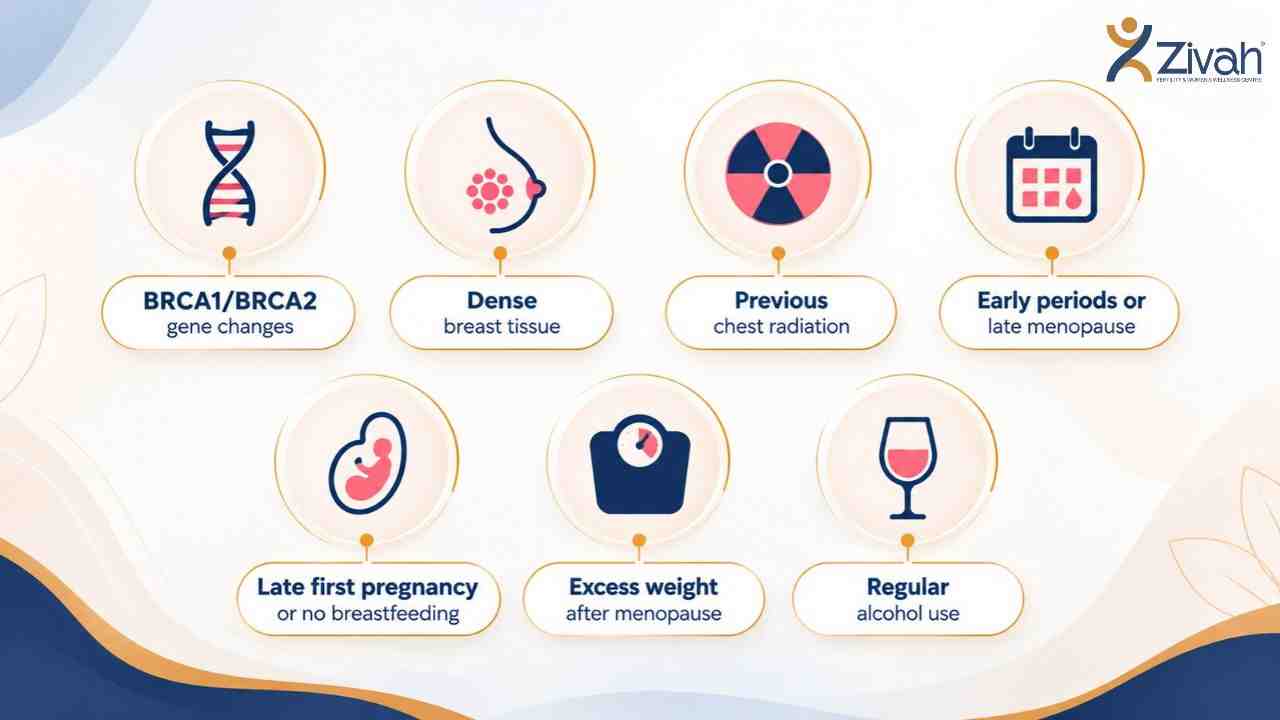
- BRCA1/BRCA2 gene changes.
- Dense breast tissue.
- Previous chest radiation.
- First period before 12 or menopause after 55.
- Late first pregnancy or no breastfeeding.
- Excess weight after menopause.
- Regular alcohol use.
Having one of these does not mean you will get breast cancer. It means your doctor may plan your screening differently.
Family History and Early Screening
A close family history often means screening starts earlier. If your mother, sister or daughter was diagnosed at a young age, your doctor may advise beginning sooner than usual. Imaging often begins around 25 to 30, or 10 years before your youngest affected relative was diagnosed.
Genetic counselling may also be suggested to check for inherited gene changes. Your risk shapes your screening timeline. The next step is knowing when that timeline begins.
When to Get Breast Cancer Screening
For women at average risk, screening follows age. The right starting point and the answer to how often women should get breast screening both shift through different stages of life.
If you have been asking, "When should I get screened for breast cancer?", the guidance below gives you a clear place to start.
Breast Cancer Screening Guidelines by Age
Breast cancer screening guidelines differ slightly between countries. India's national programme (NP-NCD) focuses on clinical breast examination for women aged 30 to 65. International bodies such as the US Preventive Services Task Force (USPSTF) and the American College of Obstetricians and Gynaecologists (ACOG) recommend mammography starting at age 40.
The table below brings both together to show when women should get breast screening at each age.
Breast Screening by Age Group (Average Risk)
| Age Group | Suggested Step | How Often |
|---|---|---|
| 20–29 | Breast self-awareness; clinical exam if your doctor advises | Ongoing awareness |
| 30–39 | Clinical breast examination | Every 5 years (NP-NCD); your doctor may advise more often |
| 40–49 | Start screening mammography, as USPSTF advises from 40, plus a clinical exam | Mammogram every 1–2 years; clinical exam at least every 5 years |
| 50–74 | Screening mammogram plus clinical exam | Mammogram every 2 years, or yearly if advised; clinical exam up to 65 |
| 75 and above | Decide with your doctor based on overall health | As advised |
These recommendations apply to women at average risk. If you have a strong family history or other risk factors, follow the earlier plan set out in the previous section.
Factors That Can Change Your Screening Interval
A screening plan is not fixed. Dense breast tissue, an earlier abnormal result, a new diagnosis in the family or a long gap since your last screen can all shorten the interval or add extra tests. Your doctor reviews the plan at each visit and adjusts it as your circumstances change. Knowing when to screen is half the picture.
The other half is knowing which test is right for you.
Common Tests Used in Breast Screening for Women
Breast screening for women is not a single test. It combines three layers: knowing your own normal, a doctor's clinical examination, and imaging when your age or risk calls for it. Each layer can catch what the others might miss.
Does a Clinical Breast Examination Replace Self-Checks?
No, the two work together. Breast self-awareness means knowing how your breasts usually look and feel, so you notice when something changes.
A clinical breast examination is a hands-on check by a trained doctor and takes only a few minutes. During the exam, the doctor looks and feels for:
- changes in breast size, shape or skin.
- lumps or thickened areas in the breast tissue.
- nipple changes or discharge.
- swollen lymph nodes (glands) in the armpit and above the collarbone.
Mammogram, Ultrasound and MRI Explained
Imaging looks deeper than any hand can feel. Your doctor chooses the test based on your age, breast density and risk level:
- Mammogram: a low-dose breast X-ray and the main screening test from age 40
- Breast ultrasound: uses sound waves, often for younger women or dense breasts
- MRI: uses magnets and radio waves, mainly for women at high risk
Some centres also offer 3D mammography (digital breast tomosynthesis). It takes images in thin layers, which can make cancers easier to spot in dense breasts. Every test has one purpose: finding cancer early.
How Early Detection of Breast Cancer Saves Lives
The earliest breast cancers are often the ones you cannot feel. They cause no pain, no lump and no visible change. This is the real importance of breast cancer screening: it finds cancer while it is still small and contained.
Early detection of breast cancer gives you more treatment choices and a far better outlook.
Early-Stage vs Late-Stage Breast Cancer
The stage at which breast cancer is found shapes almost everything that follows, from treatment to recovery. The table below shows how much changes as the cancer spreads.
How Stage at Diagnosis Changes the Picture
| Factor | Localised | Regional | Distant |
|---|---|---|---|
| Where the cancer is | Only in the breast | Nearby lymph nodes | Distant organs such as bone, lung or liver |
| How it is often found | Often on screening or as a small lump | As a lump or swollen gland | Through symptoms elsewhere in the body |
| Usual treatment | Surgery, often breast-conserving, with radiation and/or hormone therapy as needed | Surgery plus chemotherapy, radiation or hormone therapy | Ongoing treatment to control the disease |
| 5-year relative survival (American Cancer Society, SEER) | More than 99% | 87% | 32% |
These figures come from US data, and outcomes vary from woman to woman. Even so, the pattern is clear: breast cancer early detection keeps treatment simpler and survival at its highest.
Common Reasons Women Delay a Breast Check
Many women in India put off a breast check, even when something feels different. Fear of the result, embarrassment about being examined, the belief that "I'm too young for this", and putting family needs first are among the most common reasons.
Yet a clinical breast examination takes only a few minutes, and you can ask for a female doctor if that feels more comfortable. Most breast changes are also benign.
Delay is the one thing that makes early detection impossible.
Making Breast Health a Lifelong Habit
Breast health is not a single test or a one-time check. It starts with knowing your normal, recognising the changes that matter and following a screening plan suited to your age and risk. If a change doesn't settle, or you are 30 or older and have never had a clinical breast examination, now is the time to act.
Zivah Fertility in Siliguri offers complete breast care under one roof, including breast mammography, breast ultrasound and BRCA genetic testing. Consult our specialists for guidance at every step. This Breast Cancer Awareness Month, let awareness become action. That is how it turns into protection.