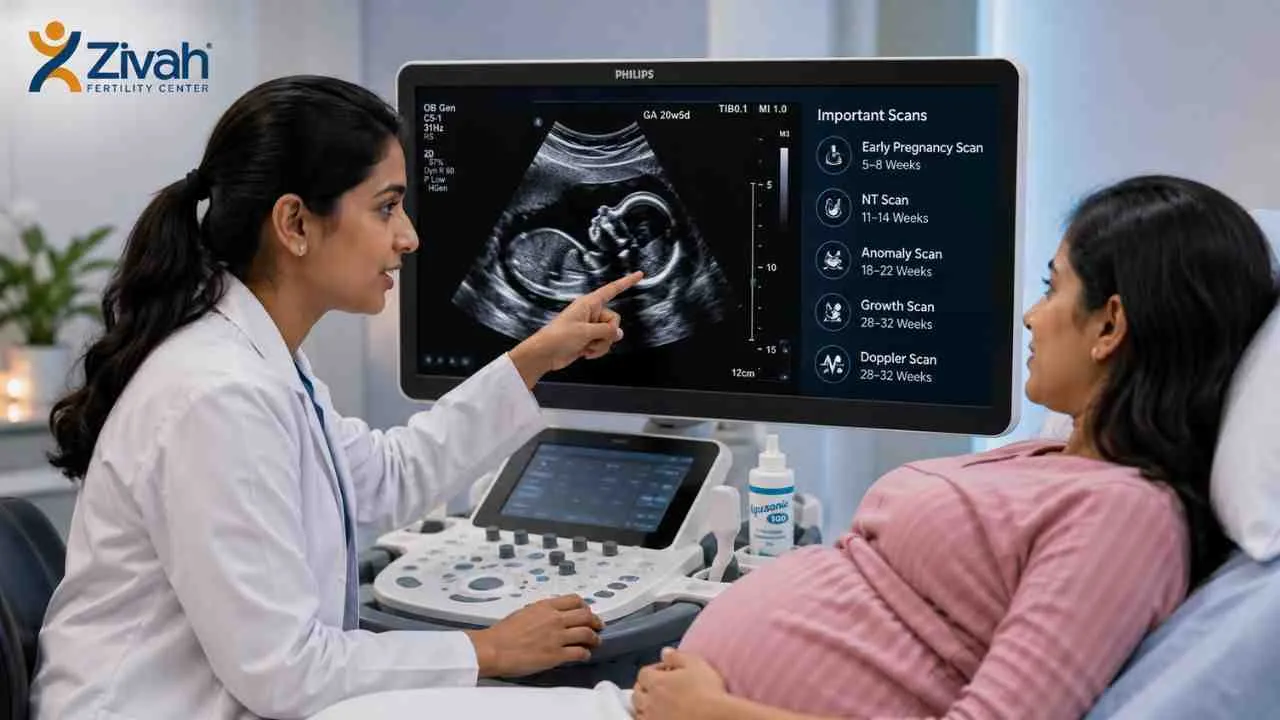
Which Scans During Pregnancy Are Important and When Are They Done?
Every scan during pregnancy explained, dating, NT, anomaly, growth and Doppler, with the week each is done and what it checks. Pregnancy scans in Siliguri.
Your doctor talks about a dating scan. Then an NT scan. Then a thing called a TIFFA. You walk out of the appointment with a list of names and no clue when any of it is really going to happen. So you have the whole picture.
This guide provides a rundown of the scans in pregnancy you are likely to have, the week and month each scan is done, what it looks for and how many pregnancy scans to expect altogether. The reassuring thing? Most healthy pregnancies do not require as many scans as people think. Now the bit worth knowing: Two of them have fixed windows and just can't be done late.
How Many Scans Do You Need During Pregnancy?
A healthy pregnancy typically requires three to five scans: a dating scan, an NT scan, an anomaly scan and one or two growth scans. If you have a high-risk pregnancy or if a scan shows something that needs additional investigation, your doctor may prescribe more scans.
The number changes more than people realise. WHO recommends a worldwide minimum of at least one scan before 24 weeks. In India, the FOGSI recommendations recommend a three-to-four scan procedure, which includes date, NT, abnormality and growth. After that, it depends on your clinic’s protocol, your age, and whether anything from an earlier scan warrants a second look.
Why Do Some Pregnancies Need More Scans?
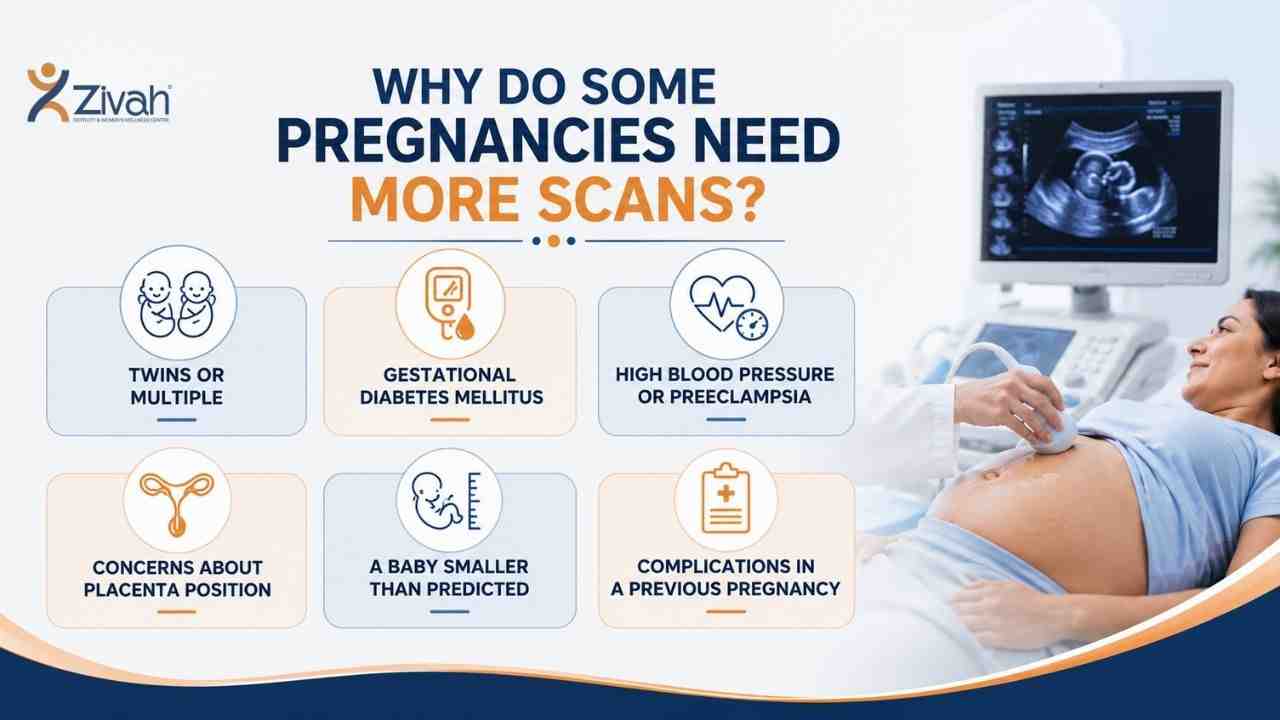
Some circumstances require further monitoring:
- Twins or multiple
- Gestational diabetes mellitus
- High blood pressure or preeclampsia
- Concerns about placenta position
- A baby smaller than predicted
- Complications in a previous pregnancy
No matter what number is yours, the series begins at the same spot.
When Is the First Ultrasound in Pregnancy?
The first pregnancy scan is usually done between 6 and 9 weeks and is called a dating scan. It confirms that the pregnancy is in the uterus, finds the fetal heartbeat, calculates the gestational age and due date, and looks for twins.
What Does the Dating Scan Check?
Four things, all of them fundamental:
- Where the pregnancy is - showing it is in the womb and ruling out an ectopic pregnancy
- The heartbeat - usually visible from around 6 weeks
- How far along you are - your gestational age and estimated due date
- How many - single, twin or more
And that third one is more important than people think. If your cycles are irregular, counting from your latest period might be off by weeks. An early ultrasound pregnancy scan delivers a far more precise due date.
Why Is the First Scan Done Transvaginally?
Because around 6 to 9 weeks, the pregnancy is just too little to see clearly through your tummy. A transvaginal ultrasound moves the probe considerably closer, so the image is crisper while everything is still small. It's routine practice this early; it's safe, and it just takes a few minutes. From around 12 weeks forward, the abdominal scans take control.
Can You Have a Scan Before 6 Weeks?
You can, although there's generally not much to see. You may not see a heartbeat until 5 or 6 weeks, which typically involves repeating the exam a week or two later. Usually these early scans are done for a purpose, such as blood or discomfort. And the remainder of the timetable is pretty much predictable from there.
Types of Scans During Pregnancy: The Full List and Schedule
There are five main types of pregnancy scans: dating, screening, anatomy, growth and Doppler. It’s not that scary if you know that every scan you will be provided will fit into one of these categories. They are distributed across the three trimesters. Confirmation and first trimester screening. The second studies the baby’s anatomy in depth.
Third measures growth and blood flow. Two of these, the NT scan and the anomaly scan, have set windows of timing that can’t be rescheduled. The others have some elbow room. Here's the full schedule all in one location.
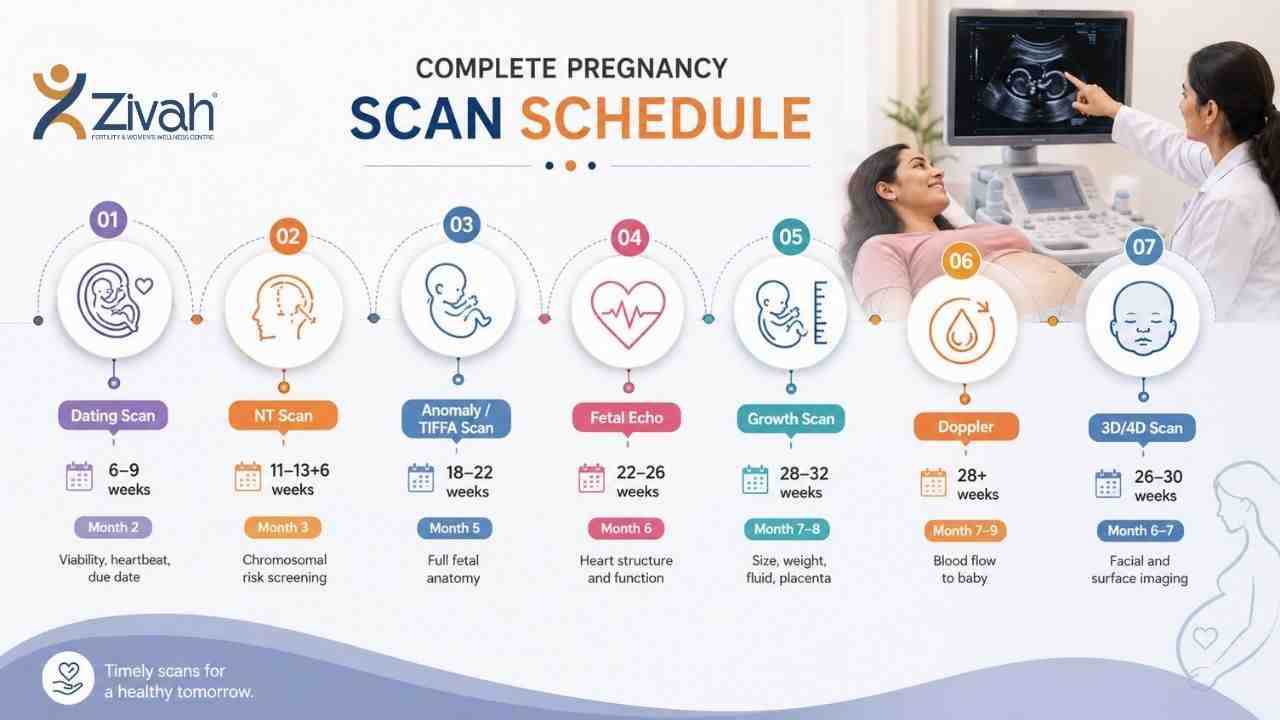
Complete Pregnancy Scan Schedule: Which Scan, Which Week, Which Month
| Scan | Week | Month | What It Checks |
|---|---|---|---|
| Dating scan | 6–9 weeks | Month 2 | Viability, heartbeat, due date, multiples |
| NT scan | 11–13+6 weeks | Month 3 | Chromosomal risk screening |
| Anomaly / TIFFA | 18–22 weeks | Month 5 | Full fetal anatomy |
| Fetal echo | 22–26 weeks | Month 6 | Heart structure and function |
| Growth scan | 28–32 weeks | Month 7–8 | Size, weight, fluid, placenta |
| Doppler | 28+ weeks, if needed | Month 7–9 | Blood flow to baby |
| 3D/4D | 26–30 weeks, optional | Month 6–7 | Facial and surface imaging |
Note: In compliance with the PCPNDT Act, 1994, sex determination is strictly prohibited and is not performed at Zivah.
Two of those rows have the tightest deadlines, thus they are worth knowing completely.
Which Scans Have a Fixed Time Window?
The NT scan must to be done between 11 weeks and 13 weeks and 6 days. This time limit is because the fluid pocket measured by the nuchal measurement will vary as the baby becomes bigger.
The anomaly scan is normally done at 18-22 weeks, 24 weeks being the outer realistic limit. Beyond that, the growth and location of the infant make a complete anatomical image more and more impossible. This is where you want to put your calendar. If either window is missed, screening is not delayed, it is lost for that pregnancy.
NT Scan and First Trimester Screening: What to Expect
Your dating scan confirmed that you were pregnant. The NT scan does something different; it is the first scan that screens for it. This is where first trimester screening begins, and where a lot of unwarranted concern begins. So it is worth knowing exactly what this scan does, and more crucially what it does not.
What Is the NT Scan and What Does It Check?
What is NT? NT stands for nuchal translucency, which is a little pocket of fluid at the back of your baby's neck. The scan determines this as a thicker measurement can be shown with an increased risk of certain chromosomal changes. It tests for three:
Down syndrome (Trisomy 21), Edwards syndrome (Trisomy 18) and Patau syndrome (Trisomy 13). It is frequently done with a dual marker blood test for more accuracy, and NIPT is offered as an extra or alternative option. Moreover, here is the important portion. The NT test is a screening test, not a diagnostic test. A high-risk result does not mean something is definite; it is a call for more testing to learn more.
What to Expect at the 12 Week Scan
This is abdominal, not internal and takes around 20-30 minutes. You may be asked to come with a full bladder, so verify with your centre in advance. By 12 weeks, there is visibly more to see than at your initial scan: arms and legs, activity, a recognisable profile.
The sonographer is measuring the nuchal fluid, the crown-to-rump length and checking early anatomy. Most centres will provide you with photos to take home. The second trimester is when the most comprehensive scan of the whole pregnancy takes place.
Second Trimester Scans: Anomaly and Fetal Echo
The first trimester is confirmed and screened. The second trimester looks structurally correct, head to toe. This is the most detailed view the baby will get before birth.
What Is the Anomaly Scan (TIFFA / Level 2 Scan)?
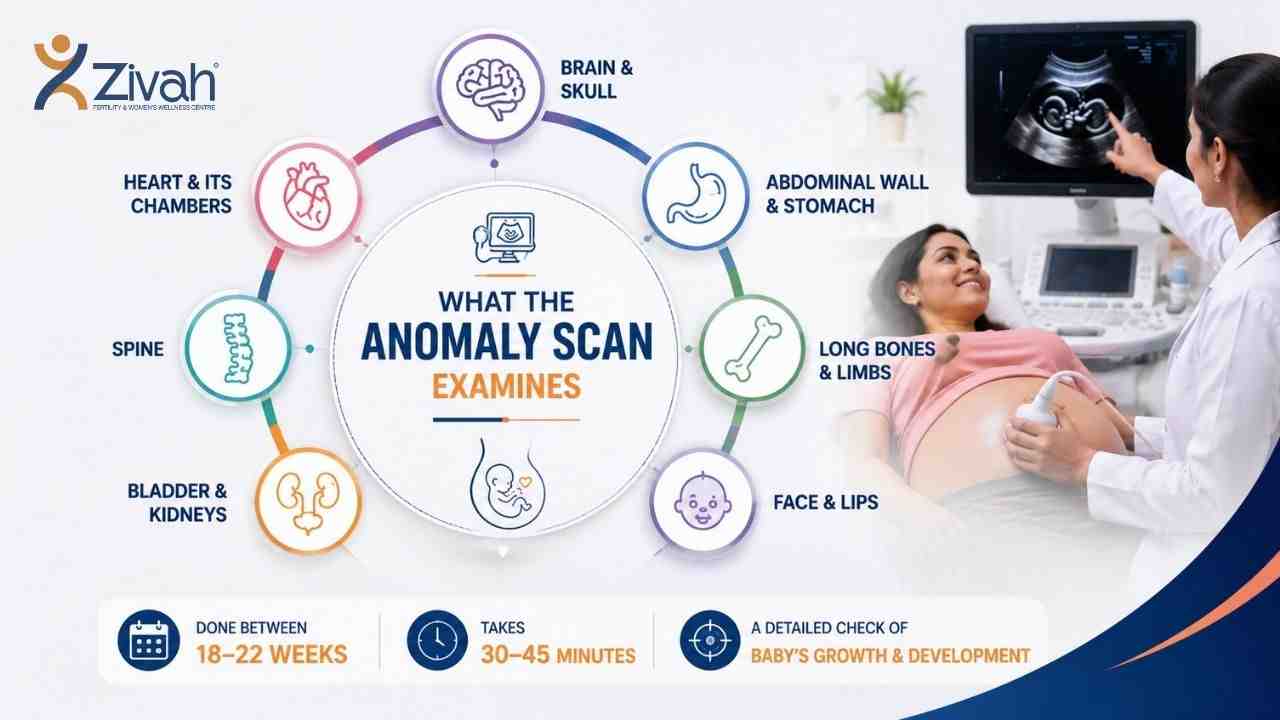
TIFFA stands for Targeted Imaging for Fetal Anomalies. It's also called the anomaly scan or the level 2 scan; they're all names for the same thing. This takes between 30 and 45 minutes and is normally done between 18 and 22 weeks – longer than any scan so far. It evaluates your placenta position, cervical length and amniotic fluid levels as well as the baby.
What the Anomaly Scan Examines
The sonographer moves through the baby methodically:
- Brain and skull
- The heart and its chambers
- Spine
- Bladder and kidneys
- Abdominal wall, stomach
- Long bones and limbs
- Face and lips
What the Anomaly Scan Cannot Detect
It's detailed but not complete. Some things just do not show up on imaging. Heart problems, hearing loss, metabolic issues, most chromosomal conditions. How much of the baby may be seen also depends on his position that day and other physical variables. A normal anomaly scan is comforting, not a promise.
When Is a Fetal Echo Scan Needed?
When do I need a fetal echo exam? A fetal echocardiogram scan offers a thorough examination of the baby's heart, its chambers, valves, rhythm and blood flow. It's most typically done at 24 weeks, but generally between 22 and 26 weeks.
This one is not routine. It may be recommended by your doctor if there is a family history of congenital cardiac disease, if you have diabetes, if there is something on the anomaly scan that needs a deeper look, or if you are on particular medications. You may learn more about fetal echocardiography at Zivah. In the third trimester, the emphasis is on growth rather than on structure.
Third Trimester Scans: Growth and Doppler
But the question has changed during the past three months. “Is everything formed correctly?”, no more. That was answered during the anomaly scan. Now it is easier: is the baby developing well, is it getting what it needs?
When Is a Growth Scan Done and What Does It Measure?
Normally between 28 and 32 weeks, occasionally repeated later to see a pattern if your doctor desires. It evaluates the baby's head circumference, abdomen circumference, femur length and estimated weight, amniotic fluid level, placental position and how the baby is resting.
The whole thing is around 20-30 minutes. In high-risk pregnancies, it may be used alongside a biophysical profile (BPP), which includes an assessment of the baby’s movement and breathing patterns.
Understanding Your Scan Report: EFW, AFI, BPD, FL and AC
Your report will be packed with acronyms. That's what they mean:
- BPD — biparietal diameter, the width of the head
- FL — femur length, the thigh bone
- AC — abdominal circumference
- EFW — estimated fetal weight
- AFI — amniotic fluid index
One thing to note: EFW is an estimate with a margin of around ± 10-15 % It's not a weighing. A number, a little over or below expectations, is not unusual and is not a problem.
Who Needs a Doppler Scan in Pregnancy?
Not all. A Doppler checks for blood flow through the umbilical cord, placenta and the baby's veins, that is, if oxygen and nutrients are flowing through adequately. It is advised for high blood pressure, diabetes, a tiny baby, twins or limited fetal movement. Read more about fetal Doppler imaging at Zivah.
Are 3D and 4D Scans Necessary?
Nope. They're not necessary, generally happen between 26 and 30 weeks, and largely about seeing your baby's features clearly before delivery. They can be useful at times in assessing surface characteristics such as a cleft lip, but they do not substitute for any medical scan. That leaves unasked the question that most parents worry about.
Are Multiple Scans Safe? Preparation and What to Expect
Yes. Pregnancy ultrasounds use sound waves, not radiation, and have no known harmful effects on mother or baby. They are still performed only when medically indicated rather than routinely, and should always be done by a trained sonographer or radiologist.
What truly occurs is straightforward. You lie on a padded table, a little quantity of gel is placed on your abdomen, and the sonographer moves a transducer over it and images show on the screen. The gel is cool to the touch, harmless, and can be wiped off later.
What Should You Bring to a Pregnancy Scan?
Well, in India, two things are legally mandated:
- Written referral or prescription from your doctor – for any pregnancy scan
- PCPNDT Requirement – Government-issued Photo ID
Things to plan for:
- A full bladder for some early abdominal scans, please confirm with your centre first
- Loose two-piece apparel, which makes it easy to get
- Eat normally prior; no need to fast
- Usually one support person is plenty. Young children are discouraged, you need to concentrate for the exam.
How Long Does a Pregnancy Scan Take?
Depends on the scan. The dating scan takes 10 to 15 minutes, the NT scan 20 to 30, the anomaly scan 30 to 45, a growth scan 20 to 30 and a Doppler 15 to 20. If yours takes a while, it’s typically because the baby is in an awkward position and the sonographer is waiting for a clearer view. It’s not often a sign that something is wrong.
How to Prepare for Each Pregnancy Scan
| Scan | What to Bring / Prepare | Approx. Duration |
|---|---|---|
| Dating scan | Prescription + photo ID; full bladder may be needed | 10–15 minutes |
| NT scan | Prescription + photo ID; full bladder usually needed | 20–30 minutes |
| Anomaly scan | Prescription + photo ID; no special preparation | 30–45 minutes |
| Growth scan | Prescription + photo ID; no special preparation | 20–30 minutes |
| Doppler | Prescription + photo ID; no special preparation | 15–20 minutes |
What If You Miss a Scan? Pregnancy Scans at Zivah
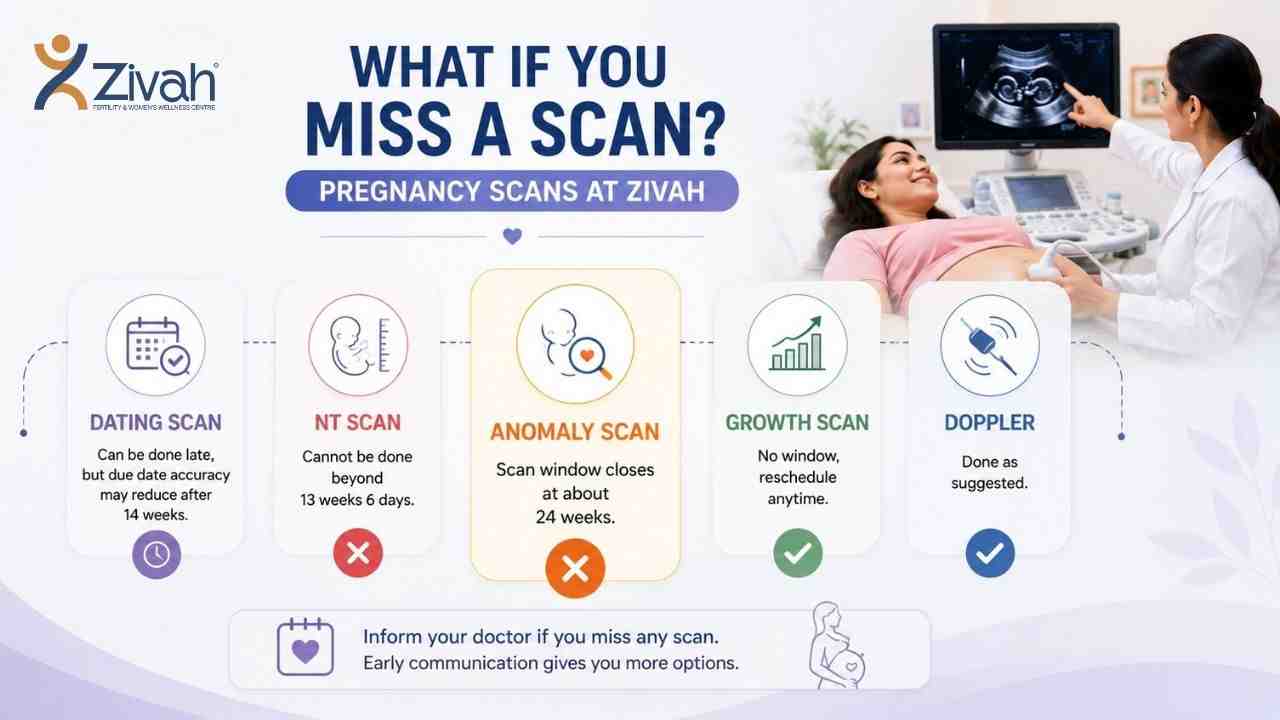
Not scanning isn’t necessarily a bad thing. Most may be rescheduled without any loss. Two can’t. If you’ve missed the NT window or the anomaly scan window, inform your doctor right away, there may still be other screening options available, but the sooner you ask, the more alternatives there will be. Here’s where each one stands:
- Dating scan – can be done late, but the accuracy of the due date is worse after 14 weeks
- NT scan – cannot be done beyond 13 weeks 6 days
- Anomaly - scan window closes at about 24 weeks
- Growth scan - no window, reschedule all you want
- Doppler - done as suggested
Booking Your Pregnancy Scans at Zivah
Zivah provides the entire prenatal imaging sequence in one location: dating, NT, anomaly/TIFFA, fetal echo, growth, and Doppler, with every report peer-reviewed by a radiologist.
Having your scans at one centre ensures your measurements are also recorded consistently throughout the pregnancy, which is particularly important when comparing growth over time.
Conclusion
Most healthy pregnancies need three to five scans, spaced evenly over the three trimesters. Save the above schedule. Mark the two fixed windows: NT scan by 13 weeks 6 days; anomaly scan by roughly 24 weeks. Please bring your picture ID and prescription to all appointments.
And check with your doctor which scans are special to you, as no two pregnancies have precisely the same list. You had a list of names and no timeline to begin with. Now you've got both.
One more thing to remember: scans during pregnancy are monitoring, not checking for danger. Most of them reaffirm that all is proceeding according to plan. Zivah in Siliguri offers a complete range of pregnancy scans when you are ready.
Frequently asked
01 How many scans are done during pregnancy in India?
02 When is the first ultrasound in pregnancy?
03 Do I need a doctor's prescription for a pregnancy scan?
04 What is the NT scan and is it compulsory?
05 What is a TIFFA scan?
06 Are multiple ultrasounds safe during pregnancy?
07 When is the growth scan done in pregnancy?
08 What happens if I miss the anomaly scan?
09 Can scans detect all birth defects?
10 What do BPD, FL, AC, EFW and AFI mean in a scan report?